Abu Qatada al-Filistini
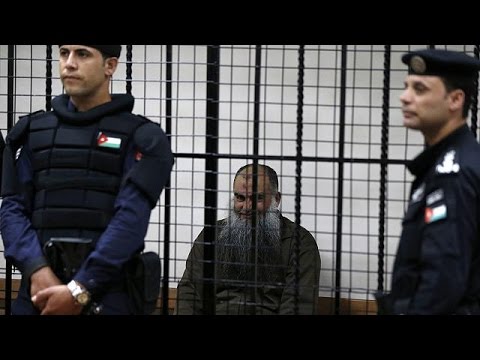
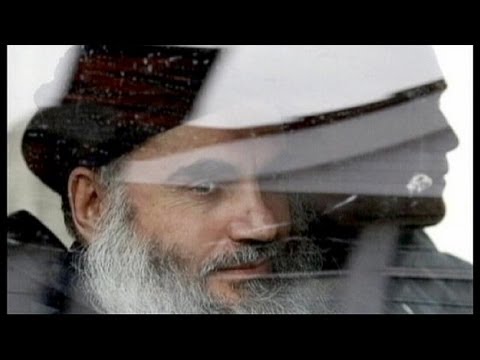
Omar Mahmoud Othman, better known as Abu Qatada al-Filistini , is a Jordanian Salafi cleric. Abu Qatada was accused of having links to terrorist organisations and frequently imprisoned in the United Kingdom without formal charges or prosecution before being deported to Jordan, where he was acquitted of multiple terrorism charges.
Abu Qatada, who was born Omar Mahmoud Othman, has Jordanian nationality because he was born in Bethlehem in the West Bank in 1960, which at that time was ruled by Jordan. In 1989, he went to Peshawar in Pakistan where he served as a professor of sharia sciences. He obtained his Bachelor's in Islamic jurisprudence in 1984 while in Jordan and his Master's in the same subject from the Peshawar University, where he became a lecturer through the influence of another Jordanian-Palestinian influential jihadi cleric, Abu Muhammad al-Maqdisi. Abu Qatada said that while in Pakistan he had no relationship to Al-Qaeda, which was just beginning to form in Afghanistan at that time. In 1991, after the Gulf War, Abu Qatada was expelled from Kuwait, along with many other Palestinians. He returned to Jordan, but in September 1993, he fled with his wife and five children to the UK, using a forged UAE passport. Citing religious persecution and stating he had been tortured in Jordan, Abu Qatada requested asylum, which was granted in June 1994.
Abu Qatada belonged to the Salafi sect, though he strongly criticised the followers of fellow Salafi Rabee al-Madkhali for being too closely aligned to the Saudi government. At the same time Abu Qatada praised fellow Salafi writer Nasiruddin Albani and considered him a great scholar. In 1995, Abu Qatada reportedly issued a fatwa stating that it is justified to kill both Muslims who renounce their faith and their families. In 1997, Abu Qatada called on Muslims to kill the wives and children of Egyptian police and army officers. In October 1999, he gave a speech at London's Four Feathers mosque in which he "effectively issued a fatwa authorising the killing of Jews, including Jewish children", according to the British case against him. He reportedly told his congregation that American citizens "should be attacked, wherever they were" and that "there was no difference between English, Jews and Americans".
Although Abu Qatada distanced himself from al-Qaeda following his arrest in London in 2001, Fawaz Gerges remarks that Abu Qatada had extensive contacts with al-Qaeda operatives in Afghanistan at the time. Jason Burke notes, "Qutada [sic] has impeccable traditional and modern Salafist credentials and had acted as the in-house alim to radical groups, particularly in Algeria, from his base in northwest London since 1994". In 2001, after bin Laden was criticised by a Salafist faction for issuing fatwas, he turned to Abu Qatada for support, and the support was forthcoming. According to the indictment of the Madrid al-Qaeda cell prepared by Spanish prosecutors in 2001,[need quotation to verify] Abu Qatada was "considered the spiritual leader" of al-Qaeda in Europe and other groups including the Armed Islamic Group (GIA), the Salafist Group for Preaching and Combat (GSPC), and the Tunisian Combat Group. Abu Qatada has been called by The Times a preacher or advisor to al-Qaeda terrorists Zacarias Moussaoui and Richard Reid. According to The Independent, videos of Abu Qatada's sermons were found in the Hamburg apartment of Mohamed Atta when it was searched after the 11 September 2001 attacks, which Atta led.
Abu Qatada was reported in February 2012 as being wanted on terrorism charges in the United States, Belgium, Spain, France, Germany, Italy and Algeria. Jordan convicted Abu Qatada in absentia; but the conviction did not hold when he appealed in person, after his removal from the UK, where he had spent over a decade in front of various courts in an ultimately vain attempt to avoid deportation. Summaries of these two procedures are given below, in the next two sections.
Convictions in Jordan and retrial acquittals
In 1999, Abu Qatada was sentenced in absentia by Jordan to life imprisonment with hard labour for conspiracy to carry out terror attacks, and subsequently he was convicted in 2000 to a further 25 years for his involvement in a plot to bomb tourists attending millennium celebrations in Jordan. The 1999 conviction related to events described by the US State Department in 1998 as involving the "Reform and Defiance Movement—a small, mostly indigenous radical Islamic group" targeting the Modern American School and a major hotel between mid-March and early May, with bombings which caused minor property damage but no casualties.[b] In 2008, the UK Court of Appeal concluded "that his 1999 conviction for terrorism was based on evidence extracted through torture". At Abu Qatada's 2012 SIAC hearing, Mr Justice Mitting observed that the evidence presented by Jordan against Abu Qatada "seems extremely thin". Overall, between 2007 and his deportation in 2013, as many as 12 senior British judges in various courts recognised the torture origins of the evidence against him.
Arrest and detention in UK
In February 2001, Abu Qatada was arrested and questioned in connection with a German terror cell. There was insufficient evidence against him, and all charges were dropped. Tapes of his sermons were later discovered in a Hamburg flat used by the 9/11 hijackers. The Home Office stated that Abu Qatada was the spiritual guide to the 9/11 ringleader Mohamed Atta. In the wake of 9/11, new anti-terror legislation was quickly introduced in the UK. Abu Qatada, who had hitherto lived with his family in Acton, west London, disappeared. His disappearance and his previous alleged contacts with MI5, prompted speculation by the Times that he was working with British intelligence and had agreed to provide them with information on suspects in the "war on terror". The Times reported that "Britain ignored warnings—which began before the 11 September attacks—from half a dozen friendly governments about Abu Qatada's links with terrorist groups and refused to arrest him. Intelligence chiefs hid from European allies their intention to use the cleric as a key informer against Islamic militants in Britain."