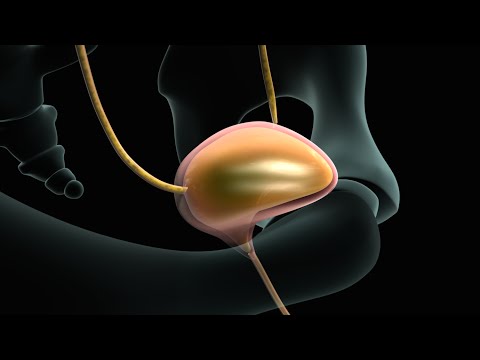
Cystoscopy
Cystoscopy is endoscopy of the urinary bladder via the urethra. It is carried out with a cystoscope.
Cystoscopy may be recommended for any of the following conditions:
If a patient has a stone lodged higher in the urinary tract, the physician may use a much finer calibre scope called a ureteroscope through the bladder and up into the ureter. (The ureter is the tube that carries urine from the kidney to the bladder.) The physician can then see the stone and remove it with a small basket at the end of a wire that is inserted through an extra tube in the ureteroscope. For larger stones, the physician may also use the extra tube in the ureteroscope to extend a flexible fiber that carries a laser beam to break the stone into smaller pieces that can then pass out of the body in the urine.[citation needed]
Imagem: Michael Reeve · BY-SA · Openverse
Physicians may have special instructions, but in most cases, patients are able to eat normally and return to normal activities after the test. Patients are sometimes asked to give a urine sample before the test to check for infection. These patients should ensure that they do not urinate for a sufficient period of time, such that they are able to urinate prior to this part of the test. Patients will have to remove their clothing covering the lower part of the body, although some physicians may prefer if the patient wears a hospital gown for the examination and covers the lower part of the body with a sterile drape. In most cases, patients lie on their backs with their knees slightly parted. Occasionally, a patient may also need to have his or her knees raised. This is particularly true when undergoing a Rigid Cystoscopy examination. For flexible cystoscopy procedures the patient is almost always alert and a local anesthetic is applied to reduce discomfort. In cases requiring a rigid cystoscopy it is not unusual for the patient to be given a general anesthetic, as these can be more uncomfortable, particularly for men. A physician, nurse, or technician will clean the area around the urethral opening and apply a local anesthetic. The local anesthetic is applied direct from a tube or needleless syringe into the urinary tract. Often, skin preparation is performed with chlorhexidine.
Blue light
In blue light cystoscopy hexyl aminolevulinate hydrochloride is instilling a photosensitizing agent, into the bladder. The blue light cystoscopy contains a light source and light is transmitted through a fluid light cable connected to an endoscope to light up the area to be observed. The photosensitizing agent preferentially accumulates porphyrins in malignant cells as opposed to nonmalignant cells of urothelial origin. Under subsequent blue light illumination, neoplastic lesions fluoresce red, enabling visualization of tumors. The blue light cystoscopy is used to detect non-muscle invasive papillary cancer of the bladder.
Imagem: Cancer Research UK · BY-SA · Openverse
Before the procedure
Prior to the early 1990s, it was common practice for the physician performing the procedure to prescribe an antibiotic to take for a few days to prevent an infection. Since that time, many urologists will order a "urine C & S" (urinalysis with bacterial/fungal cultures and testing for sensitivities to anti-infective medications) prior to the performance of the cystoscopy, and as part of the pre-operative workup. Depending on the results of the testing and other circumstances, he or she may elect to prescribe a 10- to 14-day course of antibiotic or other anti-infective treatment, commencing 3 days before the cystoscopy is to be performed, as this may alleviate some inflammation of the urethra prior to the procedure.[citation needed]
After the procedure
Patients often experience a burning sensation during urination and often see small amounts of blood in their urine. Procedures using rigid instrumentation more frequently result in short-term urinary incontinence and leakage due to urethral damage. Occasionally, patients may feel some lower abdominal pains, reflecting bladder muscle spasms, but these are not common. Common (non-invasive) prescriptions to relieve discomfort after the test may include:
Imagem: Old wombat · BY-SA · Openverse
Cystoscopy has similar indications in animals, including visualisation and biopsy of mucosa, retrieval or destruction of urinary bladder stones and diagnosis of ectopic ureters. In turtle and tortoises, cystoscopy has additional value as it permits the visualisation of internal organs due to the thin urinary bladder wall. In young individuals in which sex determination would not be feasible by visualisation of external morphologic features, this technique permits noninvasive visualisation of gonads, and therefore sex determination.