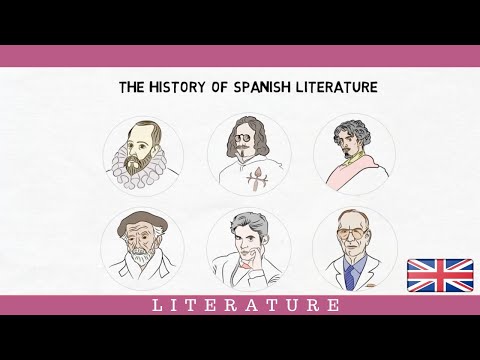
Spanish literature
Spanish literature is literature written in the Spanish language within the territory that presently constitutes the Kingdom of Spain. Its development coincides and frequently intersects with that of other literary traditions from regions within the same territory, particularly Catalan literature, Galician intersects as well with Latin, Jewish, and Arabic literary traditions of the Iberian Peninsula. The literature of Spanish America is an important branch of Spanish literature, with its own particular characteristics dating back to the earliest years of Spain’s conquest of the Americas.
The Roman conquest and occupation of the Iberian Peninsula beginning in the 3rd century BC brought a Latin culture to Spanish territories. The Muslim conquest in 711 CE brought the cultures of West Asia and the North Africa to the peninsula, creating Andalusi literary traditions. In medieval Spanish literature, the earliest recorded examples of a vernacular Romance-based literature mix Muslim, Jewish, and Christian culture. One of the notable works is the epic poem Cantar de Mio Cid, composed some time between 1140 and 1207.[dubious – discuss] Spanish prose gained popularity in the mid-thirteenth century. Lyric poetry in the Middle Ages includes popular poems and the courtly poetry of the nobles. During the 15th century the pre-Renaissance occurred and literary production increased greatly. In the Renaissance important topics were poetry, religious literature, and prose. In the 16th century the first Spanish novels appeared, Lazarillo de Tormes and Guzmán de Alfarache. In the Baroque era of the 17th century important works were the prose of Francisco de Quevedo and Baltasar Gracián. A notable author was Miguel de Cervantes Saavedra, famous for his masterpiece Don Quixote de la Mancha. In this novel Cervantes consolidated the form of literature that the picaresque novel had established in Spain to a fictional narrative that became the template for many novelists throughout the history of Spanish literature.
The Roman conquest and occupation of the peninsula, spanning from the 3rd century BCE to the 5h century CE, brought a fully developed Latin culture to Spanish territories. While the invasion of Germanic tribes in the fifth century CE put an end to Roman Spain, the tribes’ relative lack of advanced culture, including any kind of literary tradition, meant that any written literature produced in the Iberian Peninsula continued along Romanized lines. Outstanding amongst the works produced is Saint Isidore of Seville’s (c. 560–636) Etymologiae, an attempted summa of all classical knowledge. Called “the last scholar of the ancient world", St. Isidore penned theological and proto-scientific treatises, letters, and a series of histories that would serve as models for the rest of Western Europe throughout the Middle Ages. The arrival of Muslim invaders in 711 CE brought the cultures of the Middle and Far East to the Iberian Peninsula and ultimately to all of Europe. During the era of relative religious tolerance that followed, writers such as the Jewish theologian Maimonides (1135–1204) or the Muslim polymath (1126–1198) Averroes penned works of theology, science, philosophy, and mathematics that would have lasting impacts on Hebrew and Muslim philosophy and prove essential to the flowering of the European Renaissance centuries later. While none of their works can be considered direct ancestors of a Spanish literary tradition, it was out of the cultural milieu fostered by such intellectual energy that the first written manifestations of a Spanish literature proper arise.
Lyric poetry in the Middle Ages can be divided into three groups: the jarchas, the popular poems originating from folk-songs sung by commoners, and the courtly poetry of the nobles. Alfonso X of Castile fits into the third group with his series of three hundred poems, written in Galician: Las cantigas de Santa María. Another poet, Juan Ruiz, or the Arcipreste de Hita is an outstanding lyricist of the fourteenth century. His only work, Libro de buen amor is a framework tale in which he includes translations from Ovid, satires, little poems called serranillas, twenty-nine fables, a sermon on Christian armor, and many lyric poems that praise the Virgin Mary. Poet Íñigo López de Mendoza, the Marqués de Santillana (1398–1458), begins to show the movement away from the traditions of the Middle Ages. He shows a knowledge of Latin authors and familiarity with the works of Dante and Petrarch. Mendoza was also the first to introduce the sonnet into Spanish literature. The last great poet of the Middle Ages is Jorge Manrique. He is famous for his work which laments the death of his father, Coplas a la muerte de su padre. In this piece, Manrique shows classical feelings by expressing himself in a universal manner (all things come to an end). He is still considered a poet of the Middle Ages in that he finds peace and finality in religion.
Andalusi literature
The period of Islamic rule in Iberia from 711 to 1492 brought many new literary traditions to Spain. Most literature at this time was produced in standard Arabic, though poetry and other forms of literature of the Jewish golden age found expression in Judeo-Arabic or Hebrew. Maimonides, for example, wrote his magnum opus The Guide for the Perplexed in Arabic with Hebrew script. Other major literary figures of the time include Ibn Arabi, Al-Mu'tamid ibn Abbad, Ibn al-Khatib, Ibn Zaydún and Hafsa Bint al-Hajj al-Rukuniyya. Important literary styles include the muwashah, maqama, and nawba. Important works include Al-ʿIqd al-Farīd, Hayy ibn Yaqdhan, The Incoherence of the Incoherence, and Hadith Bayad wa Riyad.
The kharjas
The earliest recorded examples of a vernacular Romance-based literature date from the same time and location, the rich mix of Muslim, Jewish, and Christian cultures in Muslim Spain, in which Maimonides, Averroes, and others worked. The Jarchas, dating from the 9th to the 12th centuries C.E., were short poems spoken in local colloquial Hispano-Romance dialects, known as Mozarabic, but written in Arabic script. The Jarchas appeared at the end of longer poetry written in Arabic or Hebrew known as muwashshah, which were lengthy glosses on the ideas expressed in the jarchas. Typically spoken in the voice of a woman, the jarchas express the anxieties of love, particularly of its loss.
Cantar de Mio Cid
The epic poem Cantar de Mio Cid was written about a real man—his battles, conquests, and daily life. The poet, name unknown, wrote the epic in about 1140 and Cid supposedly died forty years before in 1099. This epic represents realism, because nothing was exaggerated and the details are very real, even the geography correctly portrays the areas in which Cid traveled and lived. Unlike other European epics, the poem is not idealized and there is no presence of supernatural beings. It has assonance instead of rhyme and its lines vary in length, the most common length being fourteen syllables. This type of verse is known as mester de juglaria (verse form of the minstrels). The epic is divided into three parts, also known as cantos.
Mester de Juglaría
Medieval Spanish poets recognized the Mester de Juglaría as a literary form written by the minstrels (juglares) and composed of varying line length and use of assonance instead of rhyme. These poems were sung to uneducated audiences, nobles and peasants alike.
Mester de Clerecía
This Castilian narrative poetry known as the Mester de Clerecía became popular in the thirteenth century. It is the verse form of the learned poets, usually clerics (hence the name 'clerecía'). The poetry was formal, with carefully counted syllables in each line. Popular themes were Christian legends, lives of saints and tales from classical antiquity. The poems were recited to villagers in public plazas. Two traits separate this form from the mester de juglaría: didacticism and erudition. Gonzalo de Berceo was one of the greatest advocates of this school, writing on religious subjects.
Spanish prose
Spanish prose gained popularity in the mid-thirteenth century when King Alfonso X of Castile gave support and recognition to the writing form. He, with the help of his groups of intellectuals, directed the composition of many prose works including Las siete partidas, the first modern book of laws of the land written in the people's language. Another work was La primera crónica general which accounted for the history of Spain from the creation until the end of Alfonso's father's reign, San Fernando. For his direction of these works and many others he directed, Alfonso X is called the father of Spanish prose. His nephew, Don Juan Manuel is famous for his prose work El Conde Lucanor which is a frame story or short stories within an overall story. In this work, the Conde Lucanor seeks advice from his wise counselor, Patronio, who gives the advice through the telling of stories. Juan Manuel also wrote lesser-known works such as El libro de los estados on the social classes and El libro del caballero y escudero on philosophical discussions. Toward the end of the Middle Ages, writer Fernando del Pulgar (1436-1490?) created a new type of prose named the verbal portrait. This form is demonstrated by Pulgar's work Claros varones de Castilla in which he represents the detailed lives of twenty-four distinguished contemporaries. He explores their moral and psychological natures as well as physical traits. Pulgar was the official historian of the monarchs Fernando and Isabel, the famous Catholic Monarchs of Spain. This position gave him close encounters with the characters in this book, making the work realistic and detailed.
The 15th century may be thought of as a pre-Renaissance period. Literary production increases greatly. Outstanding poets of this century include Juan de Mena and Íñigo López de Mendoza (Marquess of Santillana). Spanish literature of the Middle Ages concludes with La Celestina by Fernando de Rojas. Important Renaissance themes are poetry, with Garcilaso de la Vega and Juan Boscán; religious literature, with Fray Luis de León, San Juan de la Cruz, and Santa Teresa de Jesús; and prose, with the anonymous El Lazarillo de Tormes. Among the principal features of the Renaissance were the revival of learning based on classical sources, the rise of courtly patronage, the development of perspective in painting, and advances in science. The most important characteristics of the Renaissance are:
In the Baroque of the 17th century important topics are the prose of Francisco de Quevedo and Baltasar Gracián; the theater is notable (Lope de Vega, Pedro Calderón de la Barca, and Tirso de Molina); and poetry with Luis de Góngora (who is a Culteranist) and Francisco de Quevedo (who is a Conceptist). In the works of Miguel de Cervantes Saavedra notable novels are La Galatea and Don Quixote de la Mancha. The Baroque style used exaggerated motion and clear, easily interpreted detail to produce drama, tension, exuberance, and grandeur in sculpture, painting, literature, dance, and music. The Baroque is characterized by the following points:
In the Enlightenment of the 18th century, with the arrival of "the lights" to Spain, important topics are the prose of Fray Benito Jerónimo Feijoo, Gaspar Melchor de Jovellanos, and José Cadalso; the lyric of the Salmantine school (with Juan Meléndez Valdés), the lyric of the Madrilenian group (with the story-tellers Tomás de Iriarte and Félix María Samaniego), and the lyric of the Sevillian school; and also the theater, with Leandro Fernández de Moratín, Ramón de la Cruz and Vicente García de la Huerta. Enlightenment thinkers sought to apply systematic thinking to all forms of human activity, carrying it to the ethical and governmental spheres in exploration of the individual, society and the state. Three phases in the Spanish literature of the 18th century are distinguished:
Early Romanticism appeared with the singular figure of Manuel José Quintana. In Romanticism (beginning of the 19th century) important topics are: the poetry of José de Espronceda and other poets; prose, which can have several forms (the historical novel, scientific prose, the description of regional customs, journalism —where Mariano José de Larra can be mentioned—; the theater, with Ángel de Saavedra (Duke of Rivas), José Zorrilla, and other authors. In the latter romanticism (post-romanticism) some appear:Gustavo Adolfo Bécquer and Rosalía de Castro. Some anti-romantic poets are Ramón de Campoamor and Gaspar Núñez de Arce. In part a revolt against aristocratic, social, and political norms of the Enlightenment period and a reaction against the rationalization of nature, in art and literature Romanticism stressed strong emotion as a source of aesthetic experience, placing new emphasis on such emotions as trepidation, horror, and the awe experienced in confronting the sublimity of nature. It elevated folk art, nature and custom.
In Realism (end of the 19th century), which is mixed with Naturalism, important topics are the novel, with Juan Valera, José María de Pereda, Benito Pérez Galdós, Emilia Pardo Bazán, Leopoldo Alas (Clarín), Armando Palacio Valdés, and Vicente Blasco Ibáñez; poetry, with Ramón de Campoamor, Gaspar Núñez de Arce, and other poets; the theater, with José Echegaray, Manuel Tamayo y Baus, and other dramatists; and the literary critics, emphasizing Menéndez Pelayo. Realism offered depictions of contemporary life and society 'as they were'. In the spirit of general "Realism," Realist authors opted for depictions of everyday and banal activities and experiences, instead of a romanticized or similarly stylized presentation. The realistic works of this period are characterized by:
In Modernism several currents appear: Parnassianism, Symbolism, Futurism, and Creationism. Literary Modernism in Spain was influenced by the "disaster of '98", Regenerationism, and the Free Institution of Education (founded by Giner de los Ríos). Modernism was rooted in the idea that "traditional" forms of art, literature, religious faith, social organization, and daily life had become outdated; therefore it was essential to sweep them aside. The intellectual movement that thinks objectively and scientifically about the causes of the decadence of Spain as a nation between the 19th and the 20th century is called Regenerationism. It expresses a pessimist judgement about Spain. The regenerationist intellectuals divulgated their studies in journals with a big diffusion, so the movement expanded. Some important Modernist authors are Salvador Rueda, Juan Ramón Jiménez, Miguel de Unamuno and Rubén Darío.
When Franco at last died in November 1975, the important work of establishing democracy had an immediate impact on Spanish letters. Elitist narrative and poetry quickly gave way to narrative and poetry interested anew in not merely teaching (via content or style) but in delighting. Storytelling became the mantra for a new generation of Spanish novelists. Eduardo Mendoza's The Truth about the Savolta Case (1975) invited readers to escape to the roaring 1920s of Spain's pre-political, culturally vibrant Silver Age. While availing itself of various “New Novel" experiments such as narrative fragmentation, the use of mixed media, and the presence of numerous often contradictory narrative voices, Mendoza's novel could be read and enjoyed as an adventure story with romantic and dramatic appeal. Carmen Martín Gaite's 1978 novel, El cuarto de atrás, was another manifestation of the happy melding of experiment with old-fashioned storytelling, pulling readers down through various narrative levels to explore dark memories of Spain's recent political past but with the light, ironic touch of a romance novel. Over the next several years a wealth of young new writers, among them Juan José Millás, Rosa Montero, Javier Marías, Luis Mateo Díez, José María Merino, Félix de Azúa, Cristina Fernández Cubas, Enrique Vila-Matas, Carme Riera, and later Antonio Muñoz Molina and Almudena Grandes, would begin carving out a prominent place for themselves within the Spanish cultural field. During the 1980s, Spanish narrative began appearing regularly on best seller lists for the first time since the pre-war era and many of this new generation became literary and cultural celebrities, living off their work as writers with all its blessing and curses, including the obligation to publish or perish.
The Generation of 1898
The destruction of Spain's fleet in Cuba by U.S. gunboats in 1898 provoked a general cultural crisis in Spain. The "Disaster" of 1898 led established writers to seek practical political, economic, and social solutions in essays grouped under the literary heading of "Regeneracionismo". For a group of younger writers, among them Miguel de Unamuno, Pío Baroja, and José Martínez Ruiz (Azorín), the Disaster and its cultural repercussions inspired a deeper, more radical literary shift that affected both form and content. These writers, along with Ramón del Valle-Inclán, Antonio Machado, Ramiro de Maeztu, and Ángel Ganivet, came to be known as the "Generation of 98". The label from its outset was controversial and even Azorín, the source of its origin, came to reject it. Nevertheless, it stuck as a way to describe a group of writers who turned in content from the more general exploration of universal middle class values characteristic of Nineteenth Century Realism to an obsession with questions of a more national nature. Their articles, essays, poems, and novels exploring Spanish history and geography carried existential overtones, expressing overall a sense of deep malaise at the social injustice, political bungling, and cultural indifference evident in contemporary Spanish society.
The Generation of 1914 or Novecentismo
The next supposed “generation" of Spanish writers following those of ´98 already calls into question the value of such terminology. By the year 1914—the year of the outbreak of the First World War and of the publication of the first major work of the generation's leading voice, José Ortega y Gasset—a number of slightly younger writers had established their own place within the Spanish cultural field. Leading voices include the poet Juan Ramón Jiménez, the academics and essayists Ramón Menéndez Pidal, Gregorio Marañón, Manuel Azaña, Eugenio d'Ors, and Ortega y Gasset, and the novelists Gabriel Miró, Ramón Pérez de Ayala, and Ramón Gómez de la Serna. While still driven by the national and existential questions that obsessed the writers of ´98, they approached these topics with a greater sense of distance and objectivity. These writers had enjoyed more formal academic training than their predecessors, many taught within the walls of academia, and one, Azaña, was to become President and face of the Second Republic. Their genre of choice were the essay and the article, their arguments more systematic, and their tastes, more European.
The Generation of 1927
Around 1920 a younger group of writers—mostly poets—began publishing works that from their beginnings revealed the extent to which younger artists were absorbing the literary experimentation of the writers of 1898 and 1914. Poets Pedro Salinas, Jorge Guillén, Federico García Lorca, Vicente Aleixandre, Dámaso Alonso, Rafael Alberti, Luis Cernuda, Manuel Altolaguirre were likewise the most closely tied to formal academia yet. Novelists such as Benjamín Jarnés, Rosa Chacel, Francisco Ayala, and Ramón J. Sender were equally experimental and academic. Many of this generation were full-time university professors, while others spent periods as guest teachers and students. All were scholars of their national literary heritage, again evidence of the impact of the calls of “Regeneracionistas" and the Generation of 1898 for Spanish intelligence to turn at least partially inwards.
The Spanish Civil War
The Spanish Civil War, lasting from July 1936 to April 1939, had a devastating impact on the trajectory of Spanish letters. In July 1936, Spain was at the height of its Silver Age. Every major writer of the three major generations—1898, 1914, and 1927—was still alive and productive. Those of 1914 and 1927 were at the height or just reaching the height of their literary powers. Several were recognized among Western civilization's most talented and influential writers. But by April 1939, Miguel de Unamuno, Antonio Machado, and Federico García Lorca, among others, were dead. All but a small handful of the remaining writers had fled into exile, dispersed across the length of the American continent, most never to enjoy the close associations of conferences, tertulias, and theater premiers that had so often united them in pre-war Madrid.
Witnessing the early dictatorship (1939–1955)
The earliest years of the post-war were characterized more by hunger, repression, and suffering than by any significant literature. The published works of this period were true to pseudo-fascist dictator Francisco Franco's reactionary vision of a second Spanish golden age than to the material and existential anguish facing the majority of the country's population of the time. Neo-baroque poetry and paeans to Franco's Spain satisfied the censors but has enjoyed no subsequent critical shelf-life. Ironically, the narrative production of one of Franco's censors would provide the first sign of literary revival in post-war Spain. In 1942, Camilo José Cela's novel, La familia de Pascual Duarte, used just enough experimental arrangement (temporally disjointed narrative development to problematize simple accusations of political cause-effect critique; prefaces and post-scripts that confuse authorial intentions) to avoid the censors´ cuts and to present to discerning Spanish readers an exposé of a spiritually troubled, socially impoverished, and structurally violent society. Cela was to remain for the next five decades as one of Spain's most important novelists, eventually receiving the Nobel Prize for literature in 1989.
Economic and cultural renewal (1955–1975)
However, by the mid-1950s, just as with the novel, a new generation which had only experienced the Spanish civil war in childhood was coming of age. While still informed by the material social and political conditions of Spanish society, the works of Ángel González, Claudio Rodríguez, José Ángel Valente, José Agustín Goytisolo, Francisco Brines, and Gloria Fuertes among others are less politically committed. Scholars differentiate these poets´ social focus as one of communication of experience versus Hierro's and Celaya's representation of experience. That is, while these younger poets were still interested in talking about Spain, they were at least equally focused on the interactive processes of communication with the reader who was contemporaneously living these experiences. Rather than passively ingest the poet's vision of contemporary society, the poets of what came to be called variously the generation of 1956 or “of the 1960s" produced poetry that engaged the reader in the interpretation if not the production of that vision.