Al-Ma'mun
Abu al-Abbas Abd Allah ibn Harun, better known by his regnal name al-Ma'mun, was the seventh Abbasid caliph, who reigned from 813 until his death in 833. His leadership was marked by the power and prosperity of the Abbasid Caliphate; al-Ma'mun promoted the Graeco-Arabic translation movement, the flowering of learning and the sciences in Baghdad, and the publishing of al-Khwarizmi's book now known as "Algebra", making al-Ma'mun one of the most important caliphs in the Islamic Golden Age. He is also known as a proponent of the rational Islamic theology of Mu'tazilism.
Imagem: DrFO.Jr.Tn · BY-SA · Openverse
Birth and education
Abdallah, the future al-Ma'mun, was born in Baghdad on the night of 13 to 14 September 786 CE to Harun al-Rashid and his concubine Marajil, from Badghis. On the same night, which later became known as the "night of the three caliphs", his uncle al-Hadi died and was succeeded by Ma'mun's father, Harun al-Rashid, as ruler of the Abbasid Caliphate. Marajil died soon after his birth, and Abdallah was raised by Harun al-Rashid's wife, Zubayda, herself of high Abbasid lineage as the granddaughter of Caliph al-Mansur (r. 754–775). As a young prince, Abdallah received a thorough education: al-Kisa'i tutored him in classical Arabic, Abu Muhammad al-Yazidi in adab, and he received instruction in music and poetry. He was trained in fiqh by al-Hasan al-Lu'lu'i, showing particular excellence in the Hanafi school, and in the hadith, becoming himself active as a transmitter. According to M. Rekaya, "he was distinguished by his love of knowledge, making him the most intellectual caliph of the Abbasid family, which accounts for the way in which his caliphate developed".
Appointment as successor and Governor of Khurasan
Although Abdallah was the oldest of his sons, in 794 Harun named the second-born Muhammad, born in April 787 to Zubayda, as the first in line of succession. This was the result of family pressure on the Caliph, reflecting Muhammad's higher birth, as both parents descended from the Abbasid dynasty; indeed, he remained the only Abbasid caliph to claim such descent. Muhammad received the oath of allegiance (bay'ah) with the name of al-Amin ("The Trustworthy"), first in Khurasan by his guardian, the Barmakid al-Fadl ibn Yahya, and then in Baghdad. Abdallah was recognized as second heir only after entering puberty, in 799, under the name al-Ma'mun ("The Trusted One"), with another Barmakid, Ja'far ibn Yahya, as his guardian. At the same time, a third heir, al-Qasim, named al-Mu'tamin, was appointed, under the guardianship of Abd al-Malik ibn Salih.
Abbasid civil war (811–813) and Accession
In 802 Harun al-Rashid, father of al-Ma'mun and al-Amin, ordered that al-Amin succeed him, and al-Ma'mun serve as governor of Khurasan and as caliph after the death of al-Amin. In the last days of Harun's life his health was declining and saw in a dream Musa al-Kazim sitting in a chamber praying and crying, which made Harun remember how hard he had struggled to establish his own caliphate. He knew the personalities of both his sons and decided that for the good of the Abbasid dynasty, al-Ma'mun should be caliph after his death, which he confided to a group of his courtiers. One of the courtiers, Fadl ibn Rabi', did not abide by Harun's last wishes and convinced many in the lands of Islam that Harun's wishes had not changed. Later the other three courtiers of Harun who had sworn loyalty to Harun by supporting al-Ma'mun, namely, 'Isa Jarudi, Abu Yunus, and Ibn Abi 'Umran, found loopholes in Fadl's arguments, and Fazl admitted Harun had appointed al-Ma'mun after him, but, he argued, since Harun was not in his right mind, his decision should not be acted upon. Al-Ma'mun was reportedly the older of the two brothers, but his mother was a Persian woman while al-Amin's mother was a member of the reigning Abbasid family. After al-Rashid's death in 809, the relationship between the two brothers deteriorated. In response to al-Ma'mun's moves toward independence, al-Amin declared his own son Musa to be his heir. This violation of al-Rashid's testament led to a succession struggle. Al-Amin assembled a massive army at Baghdad with 'Isa ibn Mahan at its head in 811 and invaded Khorasan, but al-Ma'mun's general Tahir ibn al-Husayn (d. 822) destroyed the army and invaded Iraq, laying siege to Baghdad in 812. In 813 Baghdad fell, al-Amin was beheaded, and al-Ma'mun became the undisputed Caliph.
Imagem: CNG · BY-SA · Openverse
Early reign and Suppression of rebels: Sahl ibn Salama al-Ansari and ibn Ja'far
There were disturbances in Iraq during the first several years of al-Ma'mun's reign, while the caliph was in Merv (near present-day Mary, Turkmenistan). On 13 November 815, Muhammad ibn Ja'far al-Sadiq (al-Dibaj) claimed the Caliphate for himself in Mecca. He was defeated and he quickly abdicated asserting that he had only become caliph on news that al-Ma'mun had died. Lawlessness in Baghdad led to the formation of neighborhood watches with religious inspiration, with two notable leaders being Khalid al-Daryush and Sahl ibn Salama al-Ansari. Sahl adopted the slogan, la ta'a lil- makhluq fi ma'siyat al-khaliq, or 'no obedience to the creature in disobedience of the Creator' (originally a Kharijite slogan), alluding to what he saw as "the conflict ... between God's will and Caliphal authority". "Most" of the leadership of this vigilante movement came from the sulaahd ("men of good will of the neighborhoods and blocks") and from "popular preachers" (as both Khalid al-Daryush and Sahl ibn Salama al-Ansari were); its followers were called the 'amma, (the common people). The volunteers of the movement were known as mutawwi'a, which was the same name given to "volunteers for frontier duty and for the holy war against Byzantium". Sahl's and movement influence was such that military chiefs first "delayed capitulation to al-Ma'mun" and adopted Sahl's religious "formula" until they became alarmed at his power and combined to crush him in 817–18 CE.
Nomination of heir and dealing with bureaucracy of Baghdad (817–819)
In A.H. 201 (817 AD) al-Ma'mun named Ali al-Rida (the sixth-generation descendant of Ali and the eighth Shia Imam) as his heir as caliph. This move may have been made to appease Shi'ite opinion in Iraq and "reconcile the 'Alid and 'Abbasid branches of the Hashimite family", but in Baghdad it caused the Hashimites—supported by "military chiefs of al-Harbiyya, including Muttalib and 'Isa ibn Muhammad"—to depose al-Ma'mun and elect Ibrahim ibn al-Mahdi Caliph. According to Shia sources, the deposing of al-Ma'mun in Baghdad was not out of opposition to the wise and pious Imam al-Rida, but because of rumors spread by al-Fadl ibn Sahl. Al-Ma'mun moved Imam al-Rida to Merv in hopes of keeping watch over him, but was foiled by the Imam's growing popularity there. People from all over the Muslim world traveled to meet the prophet's grandson and listen to his teachings and guidance (according to these sources). In an attempt to humiliate the Imam, al-Ma'mun set him up with the greatest scholars of the world's religions, but the Imam prevailed and then informed al-Ma'mun that his grand vizier, Al-Fadl ibn Sahl, had withheld important information from him.
After arrival in Baghdad
The rebel forces in Baghdad splintered and wavered in opposition to al-Ma'mun. According to scholar and historian al-Tabari (839–923 CE), al-Ma'mun entered Baghdad on 11 August 819. He wore green and had others do so. Informed that compliance with this command might arouse popular opposition to the colour, on 18 August he reverted to traditional Abbasid black. While Baghdad became peaceful, there were disturbances elsewhere. In AH 210 (825–826 CE) Abdallah ibn Tahir al-Khurasani secured Egypt for al-Ma'mun, freeing Alexandria from Andalusians and quelling unrest. The Andalusians moved to Crete, where al-Tabari records their descendants were still living in his day (see Emirate of Crete). Abdallah returned to Baghdad in 211 Hijri (826–827 CE), bringing the defeated rebels with him.
Reign after 819
Al-Ma'mun's record as an administrator is also marked by his efforts toward the centralization of power and the certainty of succession. The Bayt al-Hikma, or House of Wisdom, was established during his reign. The ulama emerged as a real force in Islamic politics during al-Ma'mun's reign for opposing the mihna, which was initiated in 833, four months before he died. Michael Hamilton Morgan in his book "Lost History" describes al-Ma'mun as a man who 'Loves Learning.' al-Ma'mun once defeated a Byzantine Emperor in a battle and as a tribute, he asked for a copy of Almagest, Ptolemy's Hellenistic compendium of thoughts on astronomy written around AD 150.
Imagem: MohammadHuzam · BY-SA · Openverse
By the time al-Ma'mun became Caliph, the Arabs and the Byzantine Empire had settled down into border skirmishing, with Arab raids deep into Anatolia to capture booty and Christians to be enslaved. The situation changed however with the rise to power of Michael II in 820 AD. Forced to deal with the rebel Thomas the Slav, Michael had few troops to spare against a small Andalusian invasion of 40 ships and 10,000 men against Crete, which fell in 824 AD. A Byzantine counter offensive in 826 AD failed miserably. Worse still was the invasion of Sicily in 827 by Arabs of Tunis. Even so, Byzantine resistance in Sicily was fierce and not without success while the Arabs became quickly plagued by internal squabbles. That year, the Arabs were expelled from Sicily but they were to return.[citation needed] In 829, Michael II died and was succeeded by his son Theophilos. Theophilos experienced mixed success against his Arab opponents. In 830 AD the Arabs returned to Sicily and, after a year-long siege, took Palermo. For the next 200 years they were to remain there to complete their conquest, which was never short of Christian counters. Al-Ma'mun meanwhile launched an invasion of Anatolia in 830 AD, taking a number of Byzantine forts; he spared the surrendering Byzantines. Theophilos, for his part, captured Tarsus in 831. The next year, learning the Byzantines had killed some sixteen hundred people, al-Ma'mun returned. This time some thirty forts fell to the Caliphate's forces, with two Byzantine defeats in Cappadocia.[citation needed]
Imagem: BroXadal · BY-SA · Openverse
Al-Ma'mun conducted several astronomical and geological operations. To support his scientific efforts, al-Ma'mun built the first observatory in round city of Baghdad and subsequent observatories were built in other Abbasid cities. Al-Ma'mun was assisted by several geographer, astronomer and mathematicians from the House of Wisdom. One of these scholars was Sind ibn 'Alī, a Jewish convert to Islam who contributed to early Islamic astronomy. He participated in translating and adapting Indian astronomical tables into what became known as the Zīj al-Sindhind, and was also credited with constructing astronomical instruments and possibly overseeing the building of a kanīsa, interpreted by some sources as either an observatory or a synagogue. Around 830 CE, al-Ma'mun commissioned a group of astronomers and geographers to measure the arc from Tadmur (Palmyra) to Raqqa. They found that the two cities were separated by one degree of latitude and the corresponding meridian arc distance was .mw-parser-output .frac{white-space:nowrap}.mw-parser-output .frac .num,.mw-parser-output .frac .den{font-size:80%;line-height:0;vertical-align:super}.mw-parser-output .frac .den{vertical-align:sub}.mw-parser-output .sr-only{border:0;clip:rect(0,0,0,0);clip-path:polygon(0px 0px,0px 0px,0px 0px);height:1px;margin:-1px;overflow:hidden;padding:0;position:absolute;width:1px}66+2⁄3 Arab miles and thus they calculated the circumference of the Earth. This calculation attempt was to achieve the measurement of al-Ma'mun's arc. Using these measurements, they managed to get the circumference of the Earth to be 40,007 km. This calculation is one of the most accurate medieval calculations, the result of which is close to the modern calculation of the Earth's circumference.
Personal characteristics
Al-Tabari (v. 32, p. 231) describes al-Ma'mun as of average height, light complexion, handsome and having a long beard that lost its dark colour as he aged. He relates anecdotes concerning the caliph's ability to speak concisely and eloquently without preparation, his generosity, his respect for Muhammad and religion, his sense of moderation, justice, his love of poetry and his insatiable passion for physical intimacy. Ibn Abd Rabbih in his Unique Necklace (al-'iqd al-Farid), probably drawing on earlier sources, makes a similar description of al-Ma'mun, whom he described as of light complexion and having slightly blond hair, a long thin beard, and a narrow forehead.
Imagem: thesandiegomuseumofartcollection · BY-NC-ND · Openverse
Al-Ma'mun's first wife was Umm Isa, a daughter of his uncle al-Hadi (r. 785–786), whom he married in 804, when he was eighteen years old. They had two sons, Muhammad al-Asghar, and Abdallah. Another wife was Buran, the daughter of al-Ma'mun's vizier, al-Hasan ibn Sahl. She was born as Khadija on 6 December 807. Al-Ma'mun married her in 817, and consummated the marriage with her in December 825–January 826 in the town of Fam al-Silh. She died on 21 September 884. Al-Ma'mun had also numerous concubines. One of them, Sundus, bore him five sons, among whom was al-Abbas, who rose to become a senior military commander at the end of al-Ma'mun's reign and a contender for the throne. Her other sons were Harun, Ahmad, Isa and Isma'il. Another concubine was Arib. Born in 797, she claimed to be the daughter of Ja'far ibn Yahya, the Barmakid, stolen and sold as a child when the Barmakids fell from power. She was brought by al-Amin, who then sold her to his brother. She was a noted poet, singer, and musician. She died at Samarra in July–August 890, aged ninety-three. Another concubine was Bi'dah, known by her epithet al-Kabirah. She was also a singer, and had been a slave of Arib. She died on 10 July 915. Abu Bakr, the son of Caliph al-Muhtadi, led the funeral prayers. Another concubine was Mu'nisah, a Greek. She was one of his favourites. Another concubine was Tatrif, also known as Tazayyuf. She was an accomplished poet and a native of Basra. She was noted for beauty and elegance, and it was said that al-Ma'mun favoured her above all his other concubines. She was inconsolable at his death and mourned him in many poems. Another concubine was Badhal. She had been formerly a concubine of his cousin Ja'far bin al-Hadi, his brother al-Amin and Ali bin Hisham. She hailed from Medina and was raised in Basra. Described as charming with fair skin, she was praised for her musical talent, particularly her skill in playing instruments, and was known for her exceptional ability as a songwriter and singer. After al-Ma'mun's death, his brother al-Mu'tasim married her. Another concubine was Nu'n. She was a singer. Another concubine was Nasim. She was a poetess and was one of his favourites.
Imagem: DrFO.Jr.Tn · BY · Openverse
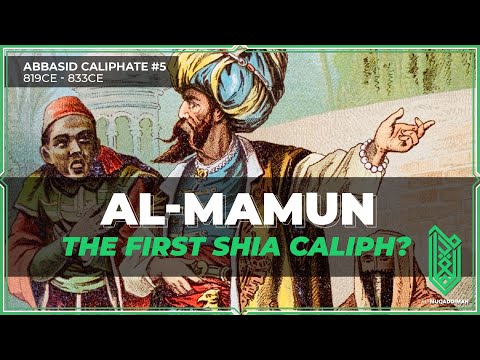
Al-Ma'mun's religious beliefs are a subject of controversy, to the point where other Abbasids, as well as later Islamic scholars, called him a Shia Muslim. For instance, Sunni scholars al-Dhahabi, Ibn Kathir, Ibn Khaldun and al-Suyuti explicitly held the belief that al-Ma'mun was a Shi'a. The arguments for his supposed Shi’ism include that, in 816/817, when Ali al-Rida, the Prophet's descendant, refused designation as sole Caliph, al-Ma'mun officially designated him as his appointed successor. The official Abbasid coins were minted showing al-Ma'mun as a Caliph and al-Rida as his successor. Other arguments were that: the Caliphate's official black colour was changed to the Prophetic green; in 210 AH/825 CE, he wrote to Qutham ibn Ja'far, the ruler of Medina, to return Fadak to the descendants of Muhammad through his daughter, Fatima; he restored nikah mut'ah, previously banned by Umar ibn al-Khattab, but practiced under Muhammad and Abu Bakr; in 211 AH/826 CE, al-Ma'mun reportedly expressed his antipathy to those who praised Mu'awiya I, the founder and first caliph of the Umayyad Caliphate, and reportedly punished such people; this later view of al-Suyuti however is questionable since it contradicts the fact that al-Ma’mun promoted scholars who openly defended Muawiyah, such as the Mu’tazilite scholar Hisham bin Amr al-Fuwati, who was a well-respected judge in the court of al-Ma’mun in Baghdad; in 212 AH/827 CE, al-Ma'mun announced the superiority of Ali ibn Abi Talib over Abu Bakr and Umar ibn al-Khattab; in 833 CE, under the influence of Muʿtazila rationalist thought, he initiated the mihna ordeal, where he accepted the argument that the Quran was created at some point over the orthodox Sunni belief that the Book is the uncreated word of God.
Imagem: MohammadAliHuzam · BY-SA · Openverse
Al-Tabari recounts how al-Ma'mun was sitting on the river bank telling those with him how splendid the water was. He asked what would go best with this water and was told a specific kind of fresh dates. Noticing supplies arriving, he asked someone to check whether such dates were included. As they were, he invited those with him to enjoy the water with these dates. All who did this fell ill. Others recovered, but al-Ma'mun died. He encouraged his successor to continue his policies and not burden the people with more than they could bear. This was on 9 August 833. Al-Ma'mun died near Tarsus. The city's major mosque (Tarsus Grand Mosque), contains a tomb reported to be his. Al-Ma'mun had made no official provisions for his succession. His son, al-Abbas, was old enough to rule and had acquired experience of command in the border wars with the Byzantines, but had not been named heir. According to the account of al-Tabari, on his deathbed al-Ma'mun dictated a letter nominating his brother, rather than al-Abbas, as his successor, and Abu Ishaq was acclaimed as caliph on 9 August, with the Laqab of al-Mu'tasim (in full al-Muʿtaṣim bi’llāh, "he who seeks refuge in God"). It is impossible to know whether this reflects actual events, or whether the letter was an invention and Abu Ishaq merely took advantage of his proximity to his dying brother, and al-Abbas's absence, to propel himself to the throne. As Abu Ishaq was the forefather of all subsequent Abbasid caliphs, later historians had little desire to question the legitimacy of his accession, but it is clear that his position was far from secure: a large part of the army favoured al-Abbas, and a delegation of soldiers even went to him and tried to proclaim him as the new Caliph. Only when al-Abbas refused them, whether out of weakness or out of a desire to avoid a civil war, and himself took the oath of allegiance to his uncle, did the soldiers acquiesce in al-Mu'tasim's succession.