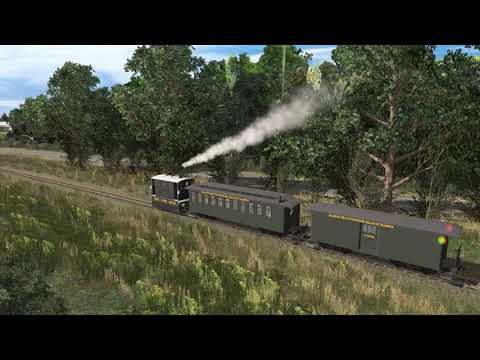
Pasoeroean Stoomtram Maatschappij
The Pasoeroean Stoomtram Maatschappij, N.V. was a private tramway in Pasuruan on the Dutch East Indies. It served passenger transport as well as goods transport of agricultural products such as sugarcane, tea and tobacco.
After Surabaya−Bangil−Pasuruan had been connected by Staatsspoorwegen railway line on May 16, 1878. There was a private investor who was interested in building a rail lineto connect the rural part of Pasuruan to the port area. The Pasoeroean Stoomtram Maatschappij (PsSM) was founded officially in 1895 based on Notarial Deed of H. W. F. Ligtenberg at 's Gravenhage (The Hague) on March, 14th also Koninklijk Besluit No.19 on March 5, 1895, operating as a tram company, proposed to the Government of the Dutch East Indies the construction of a rail network to solved the transport problems of the sugar mills and crops in the Pasuruan area, which hindered the export of agricultural products. The sugar mills (suikerfabrieken) which faced the problems were Sf. Kedawoeng, Sf. Bekassi Oost (Winongan), Sf. Gajam (Gayam), Sf. de Goede Hoop (Pengkol), Sf. Pleret (now ex textile factory Nebritex/Inbritex), Sf. Wonoredjo (Wonorejo) and Sf. Alkmaar (Purwosari).
In the beginning of the company's operation (around 1896), the PsSM imported 3 units of 0-4-0Tr (tram engine) (Type B) which were also used by Probolinggo Stoomtram Maatschappij (PbSM) (3 units) from Backer & Rueb (Machinefabriek Breda, Netherlands). However, when they were used for tough duty pulling a series of heavy sugarcane wagons, these locomotives often faced losing power (underpowered). Due to the poor performance of the engines, PsSM withdrew it from active service in 1897. After a while, PsSM imported 10 0-4-0Trs (tram engines) manufactured by Hohenzollern Locomotive Works, Germany (later became B16 during Japanese occupation and DKA/PNKA era), the first batch consisting of 5 units (08-12 series) came in 1897, also all Hohenzollern locomotives were ordered through Probolinggo from Holland with the numbers listed but some interchange of locomotives took place between the Probolinggo and Pasoeroean sister systems in the early days. Then, they acquired three John Cockerill & Cie. 0-6-0T locomotives of the 1894 manufactured year from Belgium, PsSM 6 Louisa (later became C2201 during Japanese occupation) came in 1905 and PsSM 7 Marie (later became C2202) in 1908. They also purchased a brand new of the same type later named PsSM 8 Nella (later became C2203) in 1911. The PsSM 6 and PsSM 7 were purchased from Staatsspoorwegen (SS) light rail locomotive (ex-SS 506 and SS 516). In addition, this private tram company also acquired a 0-6-0Tr (tram engine) PsSM 9 (later became type C25 No.06) from Hanomag, Germany in 1921. While the rest of five were used by Probolinggo Stoomtram as its sister company, to supported their tough duty hauling heavy sugarcane wagons, as they found that their B16s weren't so powerful enough to hauling heavy sugarcane trains. The Cockerill locomotives (Type C22s) were unusual, because they had an inside frame for the first two axles and an outside frame for the third axle. This provided more space for the firebox between the wheels but required very long crank pins on the inside framed wheels of the first two axles.
Over time, the tram was partially shut down by the PsSM, because it was not able to compete with the increasing road transport due to the ageing of rail vehicles and infrastructure. Some sections were closed during the Japanese occupation. In the decade of 1970-1980, the construction of roads was carried out on a large scale along with the increase of road traffic. The decommissioning took place as follows: