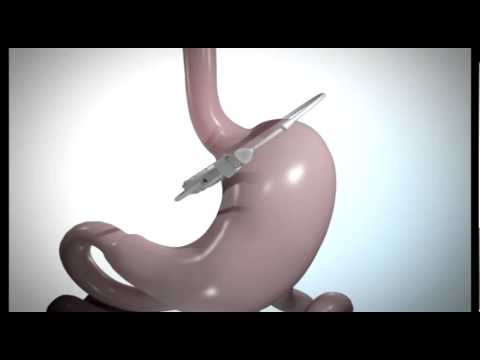
Adjustable gastric band
A laparoscopic adjustable gastric band, commonly called a lap-band, A band, or LAGB, is an inflatable silicone device placed around the top portion of the stomach to treat obesity, intended to decrease food consumption.
The inflatable band is placed around the upper part of the stomach to create a smaller stomach pouch. This slows and limits the amount of food that can be consumed at one time, thus giving the opportunity for the sense of satiety to be met with the release of peptide YY (PYY). It does not decrease gastric emptying time. The individual achieves sustained weight loss by choosing healthy food options, limiting food intake and volume, reducing appetite, and progress of food from the top portion of the stomach to the lower portion digestion. According to the American Society for Metabolic Bariatric Surgery, bariatric surgery is not an easy option for obesity sufferers. It is a drastic step, and carries the usual pain and risks of any major gastrointestinal surgical operation. However, gastric banding is the least invasive surgery of its kind and is completely reversible, with another "keyhole" operation. Gastric banding is performed using laparoscopic surgery and usually results in a shorter hospital stay, faster recovery, smaller scars, and less pain than open surgical procedures. Because no part of the stomach is stapled or removed, and the patient's intestines are not re-routed, they can continue to absorb nutrients from food normally. Gastric bands are made entirely of biocompatible materials, so they are able to stay in the patient's body without causing harm.
Placement via laparoscopic surgery
The surgical insertion of an adjustable gastric band is often referred to as a lap band procedure or band placement. First, a small incision (typically less than 1.25 cm or 0.5 in.) is made near the belly button. Carbon dioxide (a gas that occurs naturally in the body) is introduced into the abdomen to create a work space for the surgeon. Then a small laparoscopic camera is placed through the incision into the abdomen. The camera sends a picture of the stomach and abdominal cavity to a video monitor. It gives the surgeon a good view of the key structures in the abdominal cavity. A few additional small incisions are made in the abdomen. The surgeon watches the video monitor and works through these small incisions using instruments with long handles to complete the procedure. The surgeon creates a small, circular tunnel behind the stomach, inserts the gastric band through the tunnel, and locks the band around the stomach.
Mechanics
The placement of the band creates a small pouch at the top of the stomach. This pouch holds approximately 1/2 cup (~120 mL) of food, whereas the typical stomach holds about 6 cups (~1,440 mL) of food. The pouch fills with food quickly, and the band slows the passage of food from the pouch to the lower part of the stomach. As the upper part of the stomach registers as full, the message to the brain is that the entire stomach is full, and this sensation helps the person to be hungry less often, feel full more quickly and for a longer period of time, eat smaller portions, and lose weight over time. As patients lose weight, their bands will need adjustments, or "fills", to ensure comfort and effectiveness. The gastric band is adjusted by introducing a saline solution into a small access port placed just under the skin. A specialized non-coring needle is used to avoid damage to the port membrane and prevent leakage. There are many port designs (such as high profile and low profile), and they may be placed in varying positions based on the surgeon's preference, but are always attached (through sutures, staples, or another method) to the muscle wall in and around the diaphragm.
Types of adjustable bands
In the U.S. market, one adjustable gastric band is currently approved by the FDA: Lap-Band. The Lap-Band System obtained FDA approval in 2001. The Realize Band lost FDA approval in 2016. The device comes in five different sizes and has undergone modification over the years. The latest models, the Lap-Band AP-L and Lap-Band AP-S, feature a standardized injection port sutured into the skin and fill volumes of 14 mL and 10 mL respectively. Two other adjustable gastric bands are in use outside of the United States—Heliogast and Midband. Neither band has been approved by the FDA. The Midband was the first to market in 2000. In order to preserve the gastric wall in event of rubbing, the device contains no sharp edges or irregularities. It is also opaque to x-rays, making it easy to locate and adjust. The Heliogast band entered the market in 2003. The device features a streamlined band to ease insertion during the operation.
In general, gastric banding is indicated for people for whom all of the following apply: Gastric banding is usually not recommended for people with any of the following:
Special considerations for pregnancy
If considering pregnancy, ideally the patient should be in optimum nutritional condition prior to, or immediately following, conception; deflation of the band may be required prior to a planned conception. Deflation should also be considered should the patient experience morning sickness. The band may remain deflated during pregnancy and once breast feeding is completed, or if bottle feeding, the band may be gradually re-inflated to aid postpartum weight loss as needed. It is highly advised to take extra precautions during intercourse after surgery, as rapid weight loss increases fertility. Effective birth control methods must be used at all times to avoid unwanted pregnancies. Two factors have been pointed out by experts that may help explain this increase in fertility: reversal of PCOS (polycystic ovary syndrome) and reduction in the excess of estrogen, which is produced by fat cells.
Imagem: James P Gray · BY-SA · Openverse
Unlike more open forms of weight loss surgery (e.g. Roux-en-Y gastric bypass surgery (RNY), Biliopancreatic diversion (BPD) and Duodenal Switch (DS)), gastric banding does not require cutting or removing any part of the digestive system. It is removable, requiring only a laparoscopic procedure to remove the band, after which the stomach usually returns to its normal pre-banded size so it is not unusual for a person to gain weight after having a band removed. However, it is not entirely reversible as adhesions and tissue scarring are inevitable. Unlike those who have procedures such as RNY, DS, or BPD, it is unusual for gastric band patients to experience any nutritional deficiencies or malabsorption of micro-nutrients. Calcium supplements and Vitamin B12 injections are not routinely required following gastric banding (as is often the case with RNY, for example). Gastric dumping syndrome issues also do not occur since intestines are not removed or re-routed.
Potential complications
Some studies reveal there is a decrease in adjustable gastric banding surgeries due to the increased risk of reoperation, compared to Roux-en-Y gastric bypass (RYGB) or sleeve gastrectomy (SG) bariatric procedures. One commonly reported occurrence for banded patients is regurgitation of non-acidic swallowed food from the upper pouch, commonly known as Productive Burping (PBing). Productive Burping is not to be considered normal. The patient should consider eating less, eating more slowly and chewing food more thoroughly. Occasionally, the narrow passage into the larger, lower part of the stomach might also become blocked by a large portion of unchewed or unsuitable food.
Documented adverse effects
The following are the adverse effects of gastric banding as documented by the FDA.
Effectiveness
The average gastric banding patient loses 500 grams to a kilogram (1–2 pounds) per week consistently, but heavier patients often lose faster in the beginning. This comes to roughly 22 to 45 kilograms (49 to 99 pounds) the first year for most band patients. It is important to keep in mind that while most of the RNY patients drop the weight faster in the beginning, some studies have found that LAGB patients will have the same percentage of excess weight loss and comparable ability to keep it off after only a couple of years. The procedure tends to encourage better eating habits which, in turn, helps in producing long term weight stability. However, with greater experience and longer patient follow up, several studies have found suboptimal weight loss and high complication rates for the gastric band.
Band adjustments and weight loss
Correct and sensitive adjustment of the band is imperative for weight loss and the long-term success of the procedure. Adjustments (also called "fills") may be performed using an X-ray fluoroscope so that the radiologist can assess the placement of the band, the port, and the tubing that runs between the port and the band. The patient is given a small cup of liquid containing a clear or white radio-opaque fluid similar to barium. When swallowed, the fluid is clearly shown on X–ray and is observed as it travels down the esophagus and through the restriction caused by the band. The radiologist is then able to see the level of restriction in the band and to assess if there are potential or developing issues of concern. These may include dilation of the esophagus, an enlarged pouch, prolapsed stomach (when part of the stomach moves into the band where it does not belong), erosion or migration. Reflux-type symptoms may indicate too great a restriction, and further assessment may be required.
Post-surgical diet and care
The patient may be prescribed a liquid-only diet, followed by mushy foods and then solids. This is prescribed for a varied length of time and each surgeon and manufacturer varies. Some may find that before their first fill, they are still able to eat fairly large portions, because before the fill, there is little or no restriction in the band. Thus a proper post-op diet and a good after-care plan are essential to success. A recent study found that patients who did not change their eating habits were 2.2 times more likely to be unsuccessful than those who did, and that patients who had not increased their physical activity were 2.3 times more likely to be unsuccessful than those who did.
Imagem: Adjustable_gastric_banding.jpg: Original uploader was Stevenfruitsmaak at en.wikipedia derivative work: Jan Friberg (talk) · BY · Openverse
Adjustable gastric-band surgery costs about $15,000 in the United States, although state-specific averages range from about $10,500 (Colorado and Texas) to over $33,000 (Alaska). Services included in these costs vary by surgical clinic and hospital, but most practices include all services necessary to perform the procedure (surgeon's fee, surgical assistant fee, hospital/operating room fee, anesthesiologist fee and the device fee for the gastric band itself). Some practices also bundle a set duration of post-operative follow-up visits for filling and unfilling the gastric band as necessary (e.g., as many fills/unfills as necessary for anywhere from three to 13 months following surgery, depending on the practice), which as a standalone service costs between $15 and $300 per office visit. Most practices do not include within their quoted fees the cost of preoperative care and testing or any potential complications that may arise.
Imagem: Cousin Biotech · BY-NC-SA · Openverse
Non-adjustable bands
At the end of the 1970s, Wilkinson developed several surgical approaches with a common aim to limit food intake without disrupting the continuity of the gastrointestinal tract. In 1978 Wilkinson and Peloso were the first to place, by open procedure, a non-adjustable band (2 cm Marlex mesh) around the upper part of the stomach. The early 1980s saw further developments, with Kolle (Norway), Molina & Oria (U.S.), Naslund (Sweden), Frydenberg (Australia) and Kuzmack (U.S.) implanting non-adjustable gastric bands made from a variety of materials, including marlex mesh, dacron vascular prosthesis, silicone covered mesh and Gore-Tex, among others. In addition, Bashour developed the "gastro-clip", a 10.5 cm polypropylene clip with a 50cc pouch and a fixed 1.25 cm stoma, which was later abandoned because of its high rates of gastric erosion.
Adjustable bands
The development of the modern adjustable gastric band is a tribute both to the vision and persistence of the early pioneers, particularly Lubomyr Kuzmak and a sustained collaborative effort on the part of bio-engineers, surgeons and scientists. Early research on the concept of band “adjustability” can be traced back to the early work of G. Szinicz (Austria) who experimented with an adjustable band, connected to a subcutaneous port, in animals. In 1986, Lubomyr Kuzmak, a Ukrainian surgeon who had emigrated to the United States in 1965, reported on the clinical use of the "adjustable silicone gastric band" (ASGB) via open surgery. Kuzmak, who from the early 1980s had been searching for a simple and safe restrictive procedure for severe obesity, modified his original silicone non-adjustable band, which he had been using since 1983, by adding an adjustable portion. His clinical results showed improved weight loss and reduced complication rates compared with his original non-adjustable band. Kuzmak's major contributions were the application of Mason's teachings about VBG to the development of the gastric band, the volume of the pouch, the need to overcome staple line disruption, the ratification of the use of silicone and the essential element of adjustability.
The laparoscopic era
The advent of surgical laparoscopy has transformed the field of bariatric surgery and made the gastric band a more appealing option for the surgical management of obesity. In 1992, Prof. Guy-Bernard Cadière was the first to apply an adjustable band (the Kuzmak ASGB device) by the laparoscopic approach. Over the next few years, the Kuzmak ASGB was modified to make it suitable for laparoscopic implantation, eventually emerging as the modern lap band. This landmark innovation was driven by Belachew, Cadière, Favretti and O’Brien, and the Inamed Development Company engineered the device. The first human laparoscopic implantation of the newly developed lap band was performed by Belachew and le Grand on 1 September 1993 in Huy, Belgium, followed on 8 September by Cadière and Favretti in Padua, Italy. In 1993, Broadbent in Australia and Catona in Italy implanted non-adjustable (Molina-type) gastric bands by laparoscopy. In 1994, the first international laparoscopic-band workshop was held in Belgium and the first involving the SAGB was held in Sweden.
Imagem: BruceBlaus. When using this image in external sources it can be cited as: Blausen.com staff (2014). 'Medical gallery of Blausen Medical 2014'. WikiJournal of Medicine 1 (2). DOI:10.15347/wjm/2014.010. ISSN 2002-4436. · BY · Openverse
In 2012 there was a request for a congressional investigation by members of the U.S. Congress into lapband safety, prompted by recent patient deaths after lapband surgeries at clinics affiliated with the 1-800-GET-THIN advertising campaign in Southern California.
As with many developments in approaches to weight loss,[citation needed] some public figures have affected public opinion and increased awareness of gastric banding: