Abai Qunanbaiuly
Abai Qūnanbaiūly was a Kazakh poet, composer and Hanafi Maturidi theologian philosopher. He was also a cultural reformer toward European and Russian cultures on the basis of enlightened Islam. His name is also transliterated as Abay Kunanbayev ; among Kazakhs he is known as Abai.
Abai was born in Karauyl village in Chingiz volost of Semipalatinsk uyezd of the Russian Empire (this is now in Abay District of Abai Region, Kazakhstan). He was the son of Qunanbai and Uljan, his father's second wife. They named him Ibrahim, as the family was Muslim, and he stuck with the name for the first few years of his life. Ibrahim first studied at a local madrasah under Mullah Ahmed Ryza. During his early childhood years in Ryza's tutelage, he received the nickname "Abai" (which means "careful"), a nickname that stayed with him for the rest of his life. His father was wealthy enough to send Abai to a Russian secondary school in Semipalatinsk. There he read the writings of Mikhail Lermontov and Alexander Pushkin, which were influential to his own development as a writer. Moreover, he was fond of reading eastern poetry, including the Shahnameh and One Thousand and One Nights.[citation needed]
Abai's main contribution to Kazakh culture and folklore lies in his poetry, which expresses great nationalism and grew out of Kazakh folk culture. Before him, most Kazakh poetry was oral, echoing the nomadic habits of the people of the Kazakh steppes. During Abai's lifetime, however, a number of important socio-political and socio-economic changes occurred. Influence continued to grow in Kazakhstan, resulting in greater educational possibilities as well as exposure to a number of different philosophies, whether Russian, Western or Asian. Abai Qunanbaiuly steeped himself in the cultural and philosophical history of these newly opened geographies. In this sense, Abai's creative poetry affected the philosophical theological thinking of educated Kazakhs. In 1885, American journalist and explorer George Kennan visited Semey (then Semipalatinsk) and was deeply impressed by the city's public library. To his surprise, local Kazakhs actively borrowed and read books, a rare sight for that time and region. In his influential work Siberia and the Exile System, Kennan specifically mentioned Abai, marking one of the earliest references to the Kazakh thinker in Western literature.
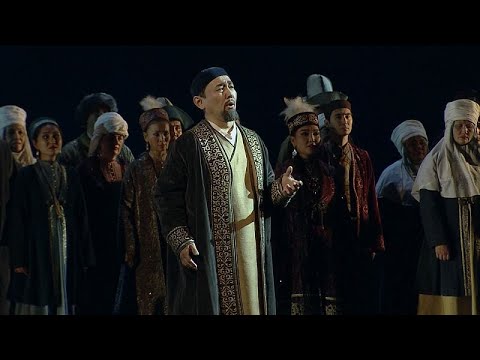
The leaders of the Alash Orda movement saw him as their inspiration and spiritual predecessor. Contemporary Kazakh images of Abai generally depict him in full traditional dress holding a dombra (the Kazakh national instrument). Today, Kazakhs revere Abai as one of the first folk heroes to enter into the national consciousness of his people. Kazakh National Pedagogical University is named after Abai, so is one of the main avenues in the city of Almaty. There are also public schools with his name. Abai is featured on postal stamps of Kazakhstan, Soviet Union, and India. The Kazakh city of Abay and the Abai Region are named after him. Among Abai's students was his nephew, a historian, philosopher, and poet Shakarim Qudayberdiuli (1858–1931). Statues of him have been erected in many cities of Kazakhstan, as well as Ashgabat, Beijing, Moscow, New Delhi, Tehran, Berlin, Cairo, Istanbul, Antalya, Kyiv, Tashkent, Sarajevo, Bucharest and Budapest.
Abai also translated into Kazakh the works of Russian and European authors, mostly for the first time. Translations made by him include poems by Mikhail Lermontov, Johann Wolfgang von Goethe, Lord Byron, Ivan Krylov's Fables and Alexander Pushkin's Eugene Onegin. Abai's major work is The Book of Words (қара сөздер, Qara sözder), a theological philosophic treatise and collection of poems where he encourages his fellow Kazakhs to embrace education, literacy, and good moral character in order to escape poverty, enslavement and corruption. In Word Twenty Five, he discusses the importance of Russian culture, as a way for Kazakhs to be exposed to the world's cultural treasures.[citation needed]
2012 Moscow protests
On 9 May 2012, after two days of protests in Moscow following Vladimir Putin's third inauguration as President of Russia, protesters set up camp near the monument to Abai on the Chistoprudny Boulevard in central Moscow, close to the embassy of Kazakhstan. The statue quickly became a reference point for the protest's participants. OccupyAbai was among the top ranking hashtags on Twitter for several days thanks to Russian opposition leader Alexei Navalny who set up a meeting with his followers next to Abai Qunanbaiuly's monument in Moscow that he called "a monument to some unknown Kazakh". This comment later led to much controversy. This also brought Abai's poetry into the top 10 AppStore downloads.
Filmography
Abai and his works have been featured numerous times in Kazakh cinema. Film expert Dana Ämırbekova compiled the movies dedicated to Abai in a list, and it included Abai's Poems (1945) by Grigori Roshal, Abai (1995) by Ardaq Ämırqūlov, and Qūnanbai (2015) by Doshan Joljaqsynov. In 2020, the Abai series were released on the Qazaqstan TV channel and the Abai joly series were released on the Khabar channel.