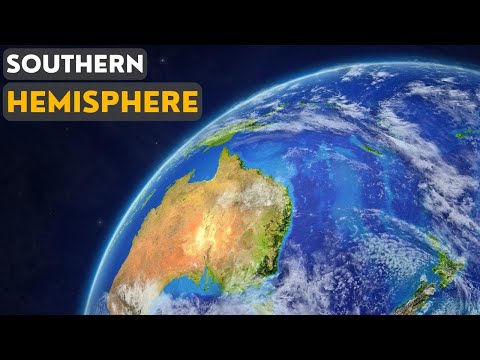
Southern Hemisphere
The Southern Hemisphere is the half (hemisphere) of Earth that is south of the equator. It contains all or part of five continents and four oceans, as well as New Zealand and most of the Pacific Islands in Oceania. Its surface is 80.9% water, compared with 60.7% water in the Northern Hemisphere, and it contains 32.7% of Earth's land. More than 850 million people live in the Southern Hemisphere, representing around 10–12% of the total global human population.
Imagem: Archives New Zealand · BY · Openverse
Southern Hemisphere climates tend to be slightly milder than those at similar latitudes in the Northern Hemisphere, except in the Antarctic which is colder than the Arctic. This is because the Southern Hemisphere has significantly more ocean and much less land; water heats up and cools down more slowly than land.[citation needed] The differences are also attributed to oceanic heat transfer and differing extents of greenhouse trapping. Antarctica's Vostok Station holds the record for the Southern Hemisphere's lowest temperature at −89.2 °C (−128.6 °F) on July 21, 1983. This is also the lowest temperature ever recorded on earth. The lowest temperature ever recorded in the Northern Hemisphere was a −69.6 °C (−93.3 °F) reading at the Klinck Automatic Weather Station in Greenland on December 22, 1991. The Southern Hemisphere's highest recorded temperature is tied at 50.7 °C (123.3 °F) between Oodnadatta, South Australia, on January 2, 1960, and Onslow, Western Australia, on January 13, 2022. Globally, a 1922 reading of 58 °C (136.4 °F) in El Azizia, Libya, was long cited as the world record before the World Meteorological Organization decertified it in 2012 due to measurement errors. The 56.7 °C (134 °F) temperature recorded in Death Valley, California, on July 10, 1913, replaced the invalidated Libya record.
Flora and Fauna
Forests in the Southern Hemisphere have special features which set them apart from those in the Northern Hemisphere. Both Chile and Australia share, for example, unique beech species or Nothofagus, and New Zealand has members of the closely related genera Lophozonia and Fuscospora. The eucalyptus is native to Australia but is now also planted in Southern Africa and Latin America for pulp production, and increasingly, biofuel uses. Some African animals like chimpanzees and gorillas live in both the Northern and Southern Hemisphere portions of Africa. Eastern gorillas are native to three Southern Hemisphere countries; Rwanda (which is entirely below the equator) and the Democratic Republic of the Congo and Uganda (which are trans-hemispheric countries). Western gorillas, meanwhile, can be found in Angola, the Democratic Republic of the Congo, Equatorial Guinea, Gabon and the Republic of the Congo, in addition to being found in the Northern Hemisphere countries Cameroon and Nigeria. The different species of chimpanzees have a much wider distribution across Africa. The common chimpanzee occurs in both hemispheres, ranging from the Northern Hemisphere countries of Guinea and Senegal in the west to Tanzania and Uganda in the east. Aside from the population in Tanzania and Uganda, populations in several countries lay partly or wholly south of the equator, including in Burundi, the Democratic Republic of the Congo, Gabon and Republic of the Congo. The bonobo, which is a distinct species from the common chimpanzee, is exclusive to the Southern Hemisphere. It is endemic to forests of the Democratic Republic of the Congo south of the Congo River. Conversely, the western chimpanzee subspecies of the common chimpanzee is confined to West Africa and the Northern Hemisphere. Its present range lies entirely north of the equator, including Ghana, Guinea, Guinea-Bissau, Ivory Coast, Liberia, Mali, Senegal and Sierra Leone.
Imagem: NASA's Marshall Space Flight Center · BY-NC · Openverse
There are 48 independent countries fully or partially in the Southern Hemisphere. The number does not take into account countries such as France and the United Kingdom, which only have land in the Southern Hemisphere via overseas territories and not through their mainlands. 34 of these countries are entirely below the equator. The two northernmost points for countries which have land in both the Northern and Southern Hemispheres are Colombia's Punta Gallinas (.mw-parser-output .geo-default,.mw-parser-output .geo-dms,.mw-parser-output .geo-dec{display:inline}.mw-parser-output .geo-nondefault,.mw-parser-output .geo-multi-punct,.mw-parser-output .geo-inline-hidden{display:none}.mw-parser-output .longitude,.mw-parser-output .latitude{white-space:nowrap}12°27′N 71°39′W / 12.450°N 71.650°W / 12.450; -71.650) and Somalia's Alula Lagoon (11°59′N 50°47′E / 11.983°N 50.783°E / 11.983; 50.783). The largest country in the Southern Hemisphere is Brazil and the smallest is Nauru. 34 of the 48 countries are also situated in the Eastern Hemisphere; Angola, Australia, Botswana, Burundi, Comoros, the Democratic Republic of the Congo, Equatorial Guinea, Eswatini, Gabon, Indonesia, Kenya, Lesotho, Madagascar, Malawi, Maldives, Mauritius, Mozambique, Namibia, Nauru, Papua New Guinea, Republic of the Congo, Rwanda, São Tomé and Príncipe, Seychelles, Solomon Islands, Somalia, South Africa, Tanzania, Timor-Leste, Tuvalu, Uganda, Vanuatu, Zambia and Zimbabwe. 11 of the 48 countries are also situated in the Western Hemisphere; Argentina, Bolivia, Brazil, Chile, Colombia, Ecuador, Paraguay, Peru, Samoa, Tonga, and Uruguay. Fiji, Kiribati and New Zealand have land in both the Eastern and Western Hemisphere, but are mostly in the Eastern Hemisphere. Kiribati is also one of the 14 countries straddling the equator, making it the only country in the world with land in all four hemispheres (excluding countries with overseas territories). Over half of Kiribati's population live on the capital South Tarawa. which is in the Eastern Hemisphere and Northern Hemisphere, and the country's default geographical coordinates are 1°25′N 173°00′E / 1.417°N 173.000°E / 1.417; 173.000, per the centroid of the country. Eswatini, Lesotho, New Zealand and Uruguay are the only Southern Hemisphere countries which are entirely outside of the tropical climate zone, as they are all below the 23°26′S latitude. Argentina, Chile and South Africa are mostly outside of the tropical climate zone, although small portions of their land reaches into the tropics.
Oceanography
Most of the South Pacific's islands are divided into the broad ethnographical regions of Melanesia and Polynesia, with the larger island of New Guinea typically being included in Melanesia and New Zealand occasionally in Polynesia. Melanesia includes Fiji, New Caledonia, Solomon Islands and Vanuatu, while Polynesia extends across the central and eastern Pacific and includes areas such as American Samoa, Cook Islands, Easter Island, French Polynesia, Niue, Samoa, Tokelau, Tonga, Tuvalu and Wallis and Futuna. Australia's east coast and parts of its northern coast are also situated in South Pacific seas, and this is where the Great Barrier Reef and most of its major cities lay. The volcanic Australian islands of Lord Howe Island and Norfolk Island are ecologically similar to tropical South Pacific islands, despite not culturally being considered part of the Melanesia and Polynesia regions. Norfolk Island, while primarily inhabited by Caucasian Australians, has evidence of prehistoric Polynesian activity from before Europeans discovered the island, as does the United Kingdom's overseas territory the Pitcairn Islands. Additionally, there are certain isolated islands closer to South America, like the Desventuradas Islands, Galápagos Islands and Juan Fernández Islands, which were discovered uninhabited by Europeans and which have no links to Melanesia and Polynesia. However, these are still geologically volcanic/oceanic islands. Some of Indonesia's islands are situated entirely in South Pacific seas, others are situated in the Indian Ocean and some border both ocean systems. Despite this, Indonesia is typically grouped with Southeast Asia rather than with the rest of the South Pacific. Timor-Leste also borders both ocean systems, and is more frequently grouped with the South Pacific than Indonesia is, but is still often regarded as Southeast Asian. Since 1945, the United Nations has categorized Australia, New Zealand, Melanesia, Polynesia and the North Pacific Micronesian islands as part of the continental designation of Oceania, with the term Oceania having been in usage as a descriptor for these areas since the early 19th century. Most sporting organizations like the Olympics also use this designation, and it is taught as a distinct continent in Latin America and parts of Europe. For statistical purposes, a geoscheme was created by the United Nations in 1970, which standardized the categorization of countries across the continental designations of Africa, America, Asia, Europe and Oceania. The geoscheme definition of Oceania does not include Indonesia or Timor-Leste, which are categorized as part of Asia. This definition also does not include Hawaii or any other North Pacific islands besides the Micronesian ones, in addition to not including the Chilean-administered Easter Island and other South Pacific islands adjacent to South America.
Geology
Among Southern Hemisphere countries, Australia, Fiji, Indonesia, Maldives, New Zealand, Papua New Guinea, Solomon Islands, Timor-Leste and Vanuatu are fully or partially on the Indo-Australian Plate, with Fiji, New Zealand, Solomon Islands, and Vanuatu also lying across boundaries with the Pacific Plate and smaller plates. Indonesia and Papua New Guinea occupy one of the most geologically complex regions on earth, being situated on the boundaries of the Indo-Australian Plate, Pacific Plate, Banda Sea Plate, Bird's Head Plate, Caroline Plate, Eurasian Plate, Maoke Plate, Philippine Sea Plate, Sunda Plate and Woodlark Plate, among other smaller plates and microplates. The Indo-Australian Plate encompasses several semi-autonomous entities and overseas territories, including the British Indian Ocean Territory, New Caledonia and Australia's Christmas Island, Cocos (Keeling) Islands, Lord Howe Island and Norfolk Island. Aside from the British Indian Ocean Territory and the Maldives, the Indo-Australian Plate's Indian component also contains the Northern Hemisphere countries India, Bangladesh, Bhutan, Pakistan and Sri Lanka, with the Indo–Australian Plate undergoing broad internal deformation and relative motion between its Indian and Australian components. Heard Island and McDonald Islands and the Kerguelen Islands lie on the Antarctic Plate as the main exposed peaks of the mostly submerged Kerguelen Plateau. The Antarctic Plate also includes Bouvet Island. The Pacific Plate extends deep into the Northern Hemisphere, and includes parts of the mainland Americas such as Los Angeles, San Diego and Mexico's Baja California Peninsula, but it is principally associated with smaller islands in the Southern Hemisphere, including American Samoa, Cook Islands, French Polynesia, Kiribati, Nauru, Niue, Pitcairn Islands, Samoa, Tokelau, Tuvalu and Wallis and Futuna. Macquarie Island lies on the boundary of the Indo-Australian Plate and Pacific Plate, while Tonga lies on the boundary of the Pacific Plate and Tonga Plate. The South American Plate does not include various South Pacific islands which were politically integrated into South America, but the plate is associated with Ascension Island, the Falklands Islands, Trindade and Martim Vaz and Brazil's Fernando de Noronha, with the Falkland Islands being situated in the Falkland Plateau tectonic boundary region. The Nazca Plate is a major plate off the Pacific coast of South America and includes Chile's Desventuradas Islands, Easter Island, Juan Fernández Islands and Salas y Gómez Island, as well as Ecuador's Galápagos Islands. The largest landmass on the Nazca Plate is Isabela Island in the Galápagos Islands. The Nazca Plate is adjacent to active regional structures including the Easter Microplate and Galápagos Microplate. The South Sandwich Islands lie on the South Sandwich Plate near the larger Scotia Plate, while South Georgia lies within the complex Scotia–South American tectonic boundary region. Several countries and islands associated with Africa lie fully or partially on the Somali Plate, including Comoros, Kenya, Madagascar, Mauritius, Mayotte, Mozambique, Réunion, Seychelles, Somalia and Tanzania. The African Plate encompasses a large portion of the South Atlantic, including Saint Helena and Tristan da Cunha, which are thousands of kilometers from mainland Africa.
Imagem: NASA Johnson · BY-NC · Openverse
Association football is generally the most popular sport across the Southern Hemisphere, particularly in South America, Indonesia and much of Southern Africa. It is the dominant spectator and participation sport in nearly all South American countries, while football has also become the most widely followed sport across much of Africa. South America is strongly associated with football, having produced numerous internationally successful national teams and clubs, although some South American countries retain additional sporting traditions that differ from the continental norm. Cricket is particularly prominent in Australia, New Zealand and South Africa, all of which have longstanding domestic competitions and internationally successful national teams; it is also followed extensively in other parts of the Southern Hemisphere, including Namibia and Zimbabwe. Rugby union has a similarly strong Southern Hemisphere presence, especially in Australia, New Zealand, South Africa and the islands of Melanesia and Polynesia. In the South Pacific, rugby union is the national sport of Fiji, New Zealand, Samoa and Tonga, and is among the region's most prominent sports. In South America, rugby union has a particularly strong following in Argentina and Uruguay, which have traditions considerably stronger than those found in most other South American countries; both are members of Sudamérica Rugby, the continental governing body for the sport.
Population
More than 850 million people live in the Southern Hemisphere, representing around 10–12% of the total global human population. Of those 850 million people, more than 203 million live in Brazil. Approximately 93% of Brazil is below the equator, and over 95% of the total population also live below the equator. More than 150 million live in Indonesia's Java, the most populous island in the world and one which is situated entirely below the equator. The most populous country in the Southern Hemisphere is Indonesia, with 275 million people. Roughly 30 million Indonesians live north of the equator on the northern portions of the islands of Sumatra, Borneo, and Sulawesi, as well as most of North Maluku. The rest of the population lives in the Southern Hemisphere, making Indonesia the country with the most inhabitants in the Southern Hemisphere.[citation needed] The most populous country entirely located within the Southern Hemisphere is Tanzania, with an estimated population of roughly 67 million people as of 2024. In terms of size, Colombia is the ninth largest overall country with any land in the Southern Hemisphere, and has a population of 53 million, although much of Colombia is above the equator. The portion of Colombia below the equator is the same size as European countries like Croatia and the Netherlands, and makes up the Amazonas Department. Colombia's most populated settlement in the Southern Hemisphere is the Amazonas Department capital city Leticia, with other Southern Hemisphere settlements being El Encanto, La Chorrera, La Pedrera, Mirití-Paraná, Puerto Alegría, Puerto Arica, Puerto Nariño, Puerto Santander and Tarapacá. Somalia has a population of 20 million, and the vast majority of the country is above the equator. Somalia's biggest settlement in the Southern Hemisphere is Kismayo, which had a population of 458,000 in 2014. The Northern and Southern Hemisphere portions of Kenya are similar in size to each other, but the country's population is concentrated in the Southern Hemisphere, with the three most populated cities Nairobi, Mombasa and Nakuru being below the equator.
Language
Portuguese is one of the most spoken languages in the Southern Hemisphere, with over 230 million speakers in six countries – mostly in Brazil, but also in Angola, Mozambique, Timor-Leste, and small parts of São Tomé and Príncipe that lie south of the equator. Spanish is the primary language in Argentina, Bolivia, Chile, Colombia, Ecuador, Equatorial Guinea, Paraguay, Peru and Uruguay. French is an official language in Gabon, French Polynesia, Mayotte, New Caledonia, Réunion and Wallis and Futuna, but is not necessarily the most widely spoken language in all of these locations. English is a primary language in Ascension Island, Australia, the British Indian Ocean Territory, the Falkland Islands, New Zealand, Norfolk Island, Saint Helena, Tristan da Cunha, Tuvalu and Uganda. English and Tuvaluan (a Polynesian language) are the official joint languages of Tuvalu, while Luganda is the most widely spoken language in Uganda, despite the official administrative language being English. Most of the other countries and states in the Southern Hemisphere have primary languages which are their own local languages rather than colonial languages. English is widely understood in South Africa, but the country has 12 official languages recognized by its national constitution, with Zulu being the most widely spoken. Some authors use the term "Southern Hemisphere English" to describe similarities between the English spoken in areas such as Australia, the Falkland Islands, New Zealand and South Africa. Outside of English and languages from immigrant communities, Australia also has more than 250 Indigenous languages, including 800 dialects. Each language is specific to a particular place and people. Australia itself has no official language, even though English is the most widely spoken.
Business and media
Important financial and commercial centers in the Southern Hemisphere include São Paulo, where the B3 (stock exchange) is headquartered, along with Sydney, home to the Australian Securities Exchange, Jakarta, the seat of the Indonesia Stock Exchange, Johannesburg, home to the Johannesburg Stock Exchange, and Buenos Aires, headquarters of the Buenos Aires Stock Exchange, the oldest stock market in the Southern Hemisphere. Elon Musk was born in the Southern Hemisphere in Pretoria, South Africa, and currently has the highest personal net worth in the world. He left South Africa as a teenager, moving to Canada in 1988 and later to the United States, where he built his fortune through ventures including Zip2, PayPal, Tesla, Inc., and SpaceX. News Corporation, founded by Melbourne-born Rupert Murdoch, was formerly one of the largest media companies in the world, owning the Hollywood studio 20th Century Fox and various newspapers, book publishers, television networks and sports teams across the globe. It reincorporated itself from an Australian company to an American company in 2004, and was delisted from the Australian stock exchange that same year. The 20th Century Fox film Avatar (2009) is the highest-grossing film of all time, with a box office return of $2,923,710,708. and was jointly shot in California, Hawaii and New Zealand. The film's director James Cameron has lived in New Zealand since 2012, and has said that the indigenous Polynesian cultures of areas like New Zealand partially inspired the alien world of the film. The highest-grossing film shot entirely in the Southern Hemisphere is the 2003 New Line Cinema film The Lord of the Rings: The Return of the King, which grossed $1,147,997,407 and was shot in New Zealand.
Currency
The currencies of the Southern Hemisphere reflect a mixture of national monetary systems, regional currency unions, and countries that use another state's currency. Australia's Australian dollar (AUD) is also used as legal tender in Kiribati, Nauru and Tuvalu. New Zealand's dollar (NZD) is used by New Zealand and also by its Polynesian territories the Cook Islands, Niue and Tokelau, while the Pitcairn Islands also use it despite being a British territory. The United States dollar (USD) is the official currency of Ecuador, including its Galápagos Islands, and is also the official currency of Timor-Leste, where the Central Bank of Timor-Leste issues centavo coins equivalent in value to US cents. In Africa, Central African CFA franc (XAF) is shared by Equatorial Guinea, Gabon and the Republic of the Congo, while Comoros uses the separate Comorian franc; in southern Africa, South Africa's rand forms the basis of the Common Monetary Area, linking South Africa, Eswatini, Lesotho and Namibia, with Eswatini's lilangeni and Lesotho's loti pegged to the rand and Namibia's Namibian dollar maintained at parity with it. Most of the remaining Southern Hemisphere states issue national currencies, including the Argentine peso, Bolivian boliviano, Brazilian real, Chilean peso, Colombian peso, Paraguayan guaraní, Peruvian sol and Uruguayan peso in South America; the Angolan kwanza, Botswana pula, Burundian franc, Congolese franc, Kenyan shilling, Malagasy ariary, Malawian kwacha, Mauritian rupee, Mozambican metical, Rwandan franc, São Tomé and Príncipe dobra, Seychellois rupee, Somali shilling, Tanzanian shilling, Ugandan shilling, Zambian kwacha and Zimbabwe Gold in Africa; and the Indonesian rupiah, Maldivian rufiyaa, Fijian dollar, Papua New Guinean kina, Samoan tālā, Solomon Islands dollar, Tongan paʻanga and Vanuatu vatu in Asia and Oceania. Some non-independent Southern Hemisphere territories add several further currency systems: French Polynesia, New Caledonia and Wallis and Futuna all use the CFP franc (XPF), the common currency of France's Pacific collectivities, issued by the Institut d'émission d'outre-mer; American Samoa uses the US dollar, while French territories such as Réunion and Mayotte use the euro. Christmas Island, the Cocos (Keeling) Islands and Norfolk Island use the Australian dollar as they are Australian external territories. Easter Island uses the Chilean peso because it is part of Chile, rather than having a separate island currency.
Tourism
Popular tourist destinations in the Southern Hemisphere include Bali, Buenos Aires, Cape Town, Easter Island, Lima, Rio de Janeiro, Sydney and Tahiti. In 2016, Lima was the most visited city in the Southern Hemisphere, and the 32nd most visited city in the world. The other Southern Hemisphere cities in the top 100 that year were Sydney, Johannesburg, Melbourne, São Paulo, Buenos Aires, Jakarta, Rio de Janeiro, Cape Town, Montevideo, Durban and Quito. According to a 2017 report, the most popular Southern Hemisphere "bucket list" destinations among Australians were Antarctica, New Zealand, the Galápagos Islands, South Africa and Peru. Quito, Ecuador is the closest major city to the equatorial line on the planet, and Ushuaia, Argentina claims the title of world's southernmost city. Ushuaia's default geographical coordinates are 54°48′S 68°18′W / 54.800°S 68.300°W / -54.800; -68.300. Cape Town, Christchurch, Hobart, Punta Arenas and Ushuaia are officially acknowledged as the five international Antarctic gateway cities that serve as primary entry points for travel to the Antarctic region.
Standard of living
Among the most developed nations in the Southern Hemisphere is Australia, with a nominal GDP per capita of US$63,487 and a Human Development Index (HDI) of 0.946, the tenth-highest in the world as of the 2024 report. New Zealand is also well developed, with a nominal GDP per capita of US$48,072 and an HDI of 0.939, putting it at number 16 in the world in 2024. The least developed nations in the Southern Hemisphere cluster in Africa and Oceania, with Mozambique and Burundi at the lowest ends of the HDI, at 0.461 (number 183 in the world) and 0.420 (number 187 in the world), respectively. The nominal GDPs per capita of these two countries do not go above US$650, a tiny fraction of the incomes enjoyed by Australians and New Zealanders. In 2025, the French overseas territory French Polynesia had the highest life expectancy for both males and females in the Southern Hemisphere (81.9 years for males and 86.6 years for females). French Polynesia also had the highest life expectancy for males and females in the Western Hemisphere, above countries such as the United States and Canada. In 2025, Africa's Lesotho had the lowest life expectancy for both males and females in the Southern Hemisphere (55.0 years for males and 60.4 years for females). The only countries with lower life expectancies for males and females in 2025 were the Northern Hemisphere African countries of the Central African Republic, Chad and Nigeria.
Imagem: jccwrt · BY · Openverse
The Southern Hemisphere has no common legal system, with countries using civil law, common law, customary law, Islamic law and hybrid systems. Road-traffic rules are an example of some of the historical differences. Argentina, Bolivia, Brazil, Chile, Colombia, Ecuador, Paraguay, Peru and Uruguay drive on the right, as do several mainland African states. Most former British territories in southern and eastern Africa drive on the left, as do many insular states in the South Atlantic, South Pacific and Indian Ocean, including Australia, as most of these states are also former British territories. Left-hand traffic is strongly associated with British and regional colonial practice, but is not confined to former British possessions: Mozambique, formerly Portuguese, drives on the left as part of the southern African road system. Indonesia and Timor-Leste also do so, as does the Northern Hemisphere country Japan, reflecting a broader trend of island countries driving on the left. The island countries Samoa and Vanuatu were exceptions to this trend, as Samoa was formerly a German colony, while Vanuatu was jointly administered by France and the United Kingdom. Samoa changed from right to left-hand traffic on September 7, 2009, making it a notable example of a deliberate modern change in road law.
Criminalization of consensual same-sex sexual activity
Legal treatment of same-sex conduct varies substantially. As of April 30, 2024, ILGA World identified 62 United Nations member states that criminalized consensual same-sex sexual activity in law or practice. Many of these are Islamic countries in the Northern Hemisphere. Consensual same-sex sexual activity remains criminalized in the Southern Hemisphere countries Burundi, Comoros, Eswatini, Kenya, Malawi, Maldives, Papua New Guinea, Solomon Islands, Somalia, Tanzania, Tonga, Uganda, Zambia and Zimbabwe. Burundi provides imprisonment of up to two years, while the Islamic nation Comoros provides imprisonment and fines for same-sex sexual conduct under its Penal Code.
Death penalty
The usage of the death penalty also varies considerably in the Southern Hemisphere. Amnesty International classified countries (as of December 31, 2025) according to whether capital punishment was abolished, retained only for exceptional offences, abolished in practice or retained for ordinary crimes. Among Southern Hemisphere countries, capital punishment is abolished for all crimes in Angola, Argentina, Australia, Bolivia, Burundi, Colombia, Republic of the Congo, Ecuador, Gabon, Madagascar, Mauritius, Mozambique, Namibia, Nauru, Papua New Guinea, Paraguay, Rwanda, São Tomé and Príncipe, Seychelles, Solomon Islands, South Africa, Timor-Leste, Tuvalu, Uruguay, Vanuatu and Zambia. Brazil, Chile, Equatorial Guinea, Peru and Zimbabwe retain it only for exceptional offences, while Eswatini, Kenya, Malawi, Maldives, Tanzania and Tonga are abolitionist in practice. Botswana, Comoros, the Democratic Republic of the Congo, Indonesia, Lesotho, Somalia and Uganda retain the death penalty for ordinary crimes. Amnesty recorded executions in Somalia in 2025, while death sentences were also recorded in several other retentionist states. Australia abolished capital punishment federally in 1973 and progressively removed it from state and territory law, making it fully abolitionist.
Penal systems
Penal systems across the Southern Hemisphere vary according to each country's legal system, population and resources. Several operate a combination of remand facilities, sentenced prisons and different security classifications, ranging from minimum or open custody to medium, high and maximum security. For example, South Africa formally classifies sentenced prisoners as minimum, medium or maximum security according to assessed security risk, while Australia likewise uses multiple classification levels, including maximum-security categories. Under Brazil's 1984 Lei de Execução Penal law, convicted prisoners are theoretically divided among closed, semi-open and open regimes, with progression toward less restrictive conditions intended as part of the rehabilitation process. Arrangements for women vary especially widely between countries because female prison populations are generally much smaller than male populations: some countries operate dedicated women's prisons, while others accommodate women in separate sections or units within larger mixed or primarily male correctional complexes. New Zealand, for example, operates three dedicated women's prisons, while in Australia both dedicated women's facilities and prisons containing separate male and female units exist. Brazil legally requires women to be held separately from men and also prohibits women's prisons from using male guards.
Indigenous laws and policies
Indigenous land law has continuing significance across much of the Southern Hemisphere. In Australia, Mabo v Queensland (No 2) (1992) rejected the application of terra nullius and recognised native title arising from the traditional laws and customs of Aboriginal and Torres Strait Islander peoples. The decision led to the Native Title Act 1993, which established a national statutory framework for recognizing and protecting native title. In New Zealand, Māori land law is shaped by Te Tiriti o Waitangi / Treaty of Waitangi and the Te Ture Whenua Māori Act 1993, which recognises Māori customary and Māori freehold land. In Bolivia, Brazil, Colombia, Ecuador and Peru, constitutional or statutory systems likewise recognise various forms of Indigenous, communal or customary territorial rights. Australia, Chile and New Zealand are all members of the CPTPP, and in 2025 they created a pact in the organization called the Birrarung Statement, which aims to increase Indigenous participation in trade activity. The pact was named after Melbourne's Yarra River (indigenously known as Birrarung) and also included the Northern Hemisphere Pacific Rim countries Canada and Mexico.
Environmental law
In Australia, environmental regulation is divided among Commonwealth, state and territory governments. The Environment Protection and Biodiversity Conservation Act 1999 protects matters of national environmental significance, including World Heritage properties and the Great Barrier Reef World Heritage Area, while the Great Barrier Reef Marine Park Act 1975 establishes the Great Barrier Reef Marine Park and the Great Barrier Reef Marine Park Authority. The Marine Park is a multiple-use protected area divided into zones with different rules for fishing, tourism, research and other activities. The Reef's World Heritage Site status adds an international conservation framework, and management increasingly incorporates Traditional Owners and traditional knowledge.
Imagem: RedAndr · BY-SA · Openverse
Most of earth's major conflicts and historical events have occurred in the Northern Hemisphere, where the majority of the world's population, historically important civilizations, and major centres of political power have been concentrated. Conflicts that have taken place entirely or partly south of the equator include the Anglo-Zulu War (1879), the First Boer War (1880–1881), the Second Boer War (1899–1902), the First World War campaigns in German South West Africa and German East Africa, the Argentine War of Independence (1810–1818), the Paraguayan War (1864–1870), the South American War of the Pacific (1879–1884), the Chaco War (1932–1935), the Angolan War of Independence (1961–1974), the Mozambican War of Independence (1964–1974), the South African Border War (1966–1990), the Mozambican Civil War (1977–1992), the Angolan Civil War (1975–2002), the Falklands War (1982), the First Congo War (1996–1997), the Second Congo War (1998–2003), and the Rwandan genocide (1994). During the Second World War, major campaigns and battles were also fought in the South Pacific, including the Japanese conquest of the Dutch East Indies (now Indonesia), the Battle of the Coral Sea, the Guadalcanal campaign and the Kokoda Track campaign. Other major non-war events include Charles Darwin's 1835 visit to the Galápagos Islands, which helped form the theory of evolution, the first release of Nelson Mandela from prison on 11 February 1990, a key moment in the eventual end of apartheid in South Africa; French nuclear weapons testing in French Polynesia between 1966 and 1996; and the 1974 "Rumble in the Jungle" boxing match between Muhammad Ali and George Foreman, held in Kinshasa in the Democratic Republic of the Congo (then Zaire). In October 1704, Scottish sailor Alexander Selkirk became marooned on the uninhabited Juan Fernández Islands, which had not been incorporated into Chile yet at that point. His experiences there inspired the 1719 book Robinson Crusoe.
Imagem: Thomas Hawk · BY-NC · Openverse
Default geographical coordinates for countries and territories in both the Northern and Southern Hemisphere
The following is the default geographic coordinates for countries and territories straddling the equator, per their centroids: