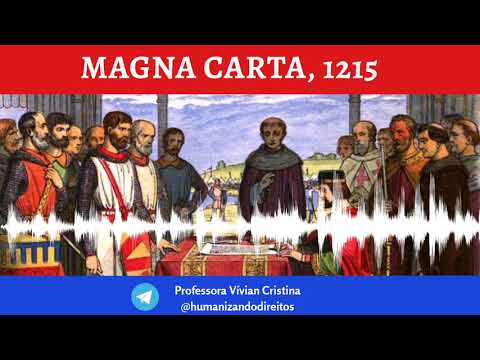
Magna Carta
Magna Carta, sometimes spelled Magna Charta, is a royal charter of rights sealed by King John of England at Runnymede, near Windsor, on 15 June 1215. First drafted by the Archbishop of Canterbury, Cardinal Stephen Langton, to make peace between the unpopular king and a group of rebel barons who demanded that the King confirm the Charter of Liberties, it promised the protection of church rights, protection for the barons from illegal imprisonment, access to swift and impartial justice, and limitations on feudal payments to the Crown, to be implemented through a council of 25 barons. Neither side stood by their commitments, and the charter was annulled by Pope Innocent III, leading to the First Barons' War.
13th century
Magna Carta originated as an unsuccessful attempt to achieve peace between royalist and rebel factions in 1215, as part of the events leading to the outbreak of the First Barons' War. England was ruled by King John, the third of the Angevin kings. Although the kingdom had a robust administrative system, the nature of government under the Angevin monarchs was ill-defined and uncertain. John and his predecessors had ruled using the principle of vis et voluntas, or "force and will", taking executive and sometimes arbitrary decisions, often justified on the basis that a king was above the law. Many contemporary writers believed that monarchs should rule in accordance with the custom and the law, with the counsel of the leading members of the realm, but there was no model for what should happen if a king refused to do so.
14th–15th centuries
During the reign of King Edward III six measures, later known as the Six Statutes, were passed between 1331 and 1369. They sought to clarify certain parts of the Charters. In particular the third statute, in 1354, redefined clause 29, with "free man" becoming "no man, of whatever estate or condition he may be", and introduced the phrase "due process of law" for "lawful judgement of his peers or the law of the land". Between the 13th and 15th centuries Magna Carta was reconfirmed 32 times according to Sir Edward Coke, and possibly as many as 45 times. Often the first item of parliamentary business was a public reading and reaffirmation of the Charter, and, as in the previous century, parliaments often exacted confirmation of it from the monarch. The Charter was confirmed in 1423 by King Henry VI.
16th century
During the 16th century, the interpretation of Magna Carta and the First Barons' War shifted. Henry VII took power at the end of the turbulent Wars of the Roses, followed by Henry VIII, and extensive propaganda under both rulers promoted the legitimacy of the regime, the illegitimacy of any sort of rebellion against royal power, and the priority of supporting the Crown in its arguments with the Papacy. Tudor historians rediscovered the Barnwell chronicler, who was more favourable to King John than other 13th-century texts, and, as historian Ralph Turner describes, they "viewed King John in a positive light as a hero struggling against the papacy", showing "little sympathy for the Great Charter or the rebel barons". Pro-Catholic demonstrations during the 1536 uprising cited Magna Carta, accusing the King of not giving it sufficient respect.
17th–18th centuries
With the accession of James VI of Scotland of the House of Stuart to the English throne in 1603, when Elizabeth I of England died childless ending the Tudor dynasty, he became James of England, ruling each kingdom separately in a composite monarchy. There were separate parliaments in each kingdom and separate legal traditions. James believed in the divine right of kings and had ruled Scotland without limits on his power. In England under the Stuart kings, Magna Carta became increasingly important as a political document in arguments over the authority of the English monarchy. James I and Charles I both propounded greater authority for the Crown, justified by the doctrine of the divine right of kings, and Magna Carta was cited extensively by their opponents to challenge the monarchy.
19th–21st centuries
Initially, the Whig interpretation of Magna Carta and its role in constitutional history remained dominant during the 19th century. The historian William Stubbs's Constitutional History of England, published in the 1870s, formed the high-water mark of this view. Stubbs argued that Magna Carta had been a major step in the shaping of the English nation, and he believed that the barons at Runnymede in 1215 were not just representing the nobility, but the people of England as a whole, standing up to a tyrannical ruler in the form of King John. This view of Magna Carta began to recede. The late-Victorian jurist and historian Frederic William Maitland provided an alternative academic history in 1899, which began to return Magna Carta to its historical roots. In 1904, Edward Jenks published an article entitled "The Myth of Magna Carta", which undermined the previously accepted view of Magna Carta. Historians such as Albert Pollard agreed with Jenks in concluding that Edward Coke had largely "invented" the myth of Magna Carta in the 17th century; these historians argued that the 1215 charter had not referred to liberty for the people at large, but rather to the protection of baronial rights.
Physical format
Numerous copies, known as exemplifications, were made of the various charters, and many of them still survive. The documents were written in heavily abbreviated medieval Latin in clear handwriting, using quill pens on sheets of parchment made from sheep skin, approximately 15 by 20 inches (380 by 510 mm) across. They were sealed with the royal great seal by an official called the spigurnel, equipped with a special seal press, using beeswax and resin. There were no signatures on the charter of 1215, and the barons present did not attach their own seals to it. The text was not divided into paragraphs or numbered clauses: the numbering system used today was introduced by the jurist Sir William Blackstone in 1759.
Exemplifications
At least thirteen original copies of the charter of 1215 were issued by the royal chancery during that year, seven in the first tranche distributed on 24 June and another six later; they were sent to county sheriffs and bishops, who were probably charged for the privilege. Slight variations exist between the surviving copies, and there was probably no single "master copy". Of these documents, only four survive, all held in England: two now at the British Library, one at Salisbury Cathedral, and one, the property of Lincoln Cathedral, on permanent loan to Lincoln Castle. Each of these versions is slightly different in size and text, and each is considered by historians to be equally authoritative.
Most of the 1215 charter and later versions sought to govern the feudal rights of the Crown over the barons. Under the Angevin kings, and in particular during John's reign, the rights of the King had frequently been used inconsistently, often in an attempt to maximise the royal income from the barons. Feudal relief was one way that a king could demand money, and clauses 2 and 3 fixed the fees payable when an heir inherited an estate or when a minor came of age and took possession of his lands. Scutage was a form of medieval taxation. All knights and nobles owed military service to the Crown in return for their lands, which theoretically belonged to the King. Many preferred to avoid this service and offer money instead. The Crown often used the cash to pay for mercenaries. The rate of scutage that should be payable, and the circumstances under which it was appropriate for the King to demand it, was uncertain and controversial. Clauses 12 and 14 addressed the management of the process.
Clauses remaining in English law
Only three clauses of Magna Carta still remain on the statute book of England and Wales. These concern 1) the freedom of the English Church, 2) the "ancient liberties" of the City of London (clause 13 in the 1215 charter, clause 9 in the 1297 statute), and 3) a right to due legal process (clauses 39 and 40 in the 1215 charter, clause 29 in the 1297 statute). Using the numbering system from the 1297 statute, these clauses are traditionally translated into English as follows:
Clauses in force in other countries
Clauses of Magna Carta also remain in force in several countries that were formerly British colonies. British colonies received the common and statutory law in force at a particular time in England, often through specific reception statutes or by adoption into local law. As a result, clause 29 of the 1297 version remains in force in New Zealand and the Australian states of New South Wales, Victoria, Queensland and the Australian Capital Territory. The entirety of Magna Carta apart from clause 26 remains in force in the Australian states of Western Australia, Tasmania, South Australia and the Northern Territory.