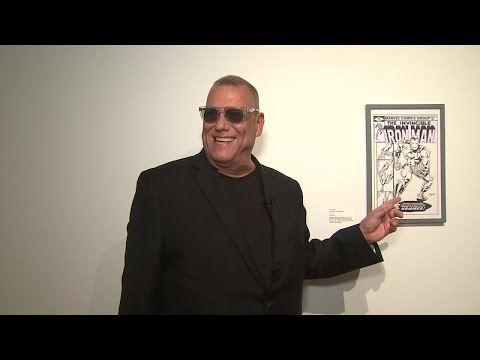
Bob Layton
Bob Layton is an American comic book artist, writer, and editor. He is best known for his work on Marvel Comics titles such as Iron Man and Hercules, and for co-founding Valiant Comics with Jim Shooter.
Imagem: 5of7 · BY-SA · Openverse
Bob Layton was born on September 25, 1953. He learned to read comics from the age of four, explaining that his "older sister Sue became bored with reading the same comic to me about fifty times. (It was a Showcase featuring the Challengers of the Unknown.)" After leaving high school, Layton began "playing comics dealer ... selling them out of his apartment in Indianapolis," through which he met Roger Stern in 1973, while the latter was working for a radio station in Indianapolis.
CPL
Layton and Stern began publishing a fanzine called CPL (Contemporary Pictorial Literature) out of Layton's apartment. Stern recalls that, "CPL started out as Bob's sale catalog. Bob was drawing the covers and including little reviews written by some of his customers. By issue #5, it turned into a small 'zine with a catalog insert, and I started writing short articles for it. I eventually became an editor of sorts." CPL rapidly became a popular fan publication, and led to the two forming an alliance with Charlton Comics to produce and publish "the now-famous Charlton Bullseye magazine." During the mid-1970s, both Marvel and DC were publishing in-house "fan" publications (FOOM and The Amazing World of DC Comics respectively), and Charlton wished to make inroads into the superhero market, as well as "establish a fan presence", leading to the alliance with CPL to produce the Charlton Bullseye. This led to Charlton giving Layton and Stern "access to unpublished material from their vaults by the likes of Steve Ditko, Jeff Jones and a host of others." This association with Charlton (and Bill Pearson, production manager) in turn led to Layton becoming acquainted with Wally Wood, with whom he apprenticed. This apprenticeship led to work for Charlton on anthology titles, but not working from the Charlton offices, Marvel Comics and DC Comics, while still publishing fanzines.
Marvel Comics and DC Comics
Layton's first, albeit uncredited, work for Marvel Comics was inking a single page in the Marvel UK title The Avengers and the Savage Sword of Conan #135 (April 17, 1976). Part of Layton's role as Wally Wood's apprentice included him occasionally delivering artwork to "NYC from Connecticut." Layton recalls that: One day, I was in the Marvel offices ... handing in Woody's pages to the production dept. So, I used the opportunity to show my samples around while I had 'my foot in the door'. When I passed the art director's office, I heard John Romita on the phone, frantically trying to find someone to ink a desperately late issue of Iron Man [by George Tuska]. Like an idiot, I stuck my head in his doorway and said I could get the job done in the four or five days that was left on the schedule. It was an utter fabrication ... but I really wanted to work for Marvel Comics! Johnny gave me the pages and said, 'Show me what you can do, kiddo.'
Valiant Comics
Bob Layton was one of the chief architects of the Valiant Universe, along with Jim Shooter, Barry Windsor-Smith, Steven J. Massarsky, and Jon Hartz. He co-created a number of the core characters including X-O Manowar, and later became Editor-in-Chief and Senior Vice President, during which time he controlled the company during its most profitable period. His first Valiant work appeared in Magnus, Robot Fighter #1 (May 1991), in which he inked Art Nichols' artwork from Jim Shooter's script. He would continue with Magnus for five issues and produce covers to issue #9, while inking the inaugural issues of Solar, Man of the Atom, which he edited. In February 1992, he co-created with Shooter and Steve Englehart and penciled the first issue of X-O Manowar, after which he handed over the core art duties to Sal Velluto, but provided inks for #2. The following month he drew the cover to David Michelinie's Rai.
Return to DC and Marvel
In 1998, he returned to DC, re-teaming briefly with penciler Sal Velluto on a story in September 1998's The New Gods Secret Files and Origins, before collabotaring with his fellow Floridian and artistic friend/mentor Dick Giordano on several projects. The two-issue prestige format Elseworlds tale Batman: Dark Knight of the Round Table was co-drawn and co-inked by the both of them, from a script by Layton and debuted a month after their six-issue mini-series The L.A.W. (Living Assault Weapons), which ran from September 1999 to February 2000, with script and inks by Layton, and full pencils by Giordano. The two wrote a second Batman Elseworlds tale, Batman: Hollywood Knight a three-issue mini-series which told the story of a Serials-actor who became convinced he was The Batman. It was written by Layton with pencils and inks by Giordano.
2000s
In December 2000, Layton launched Future Comics, with Dick Giordano, Allen Berrebbi, and David Michelinie. Layton acted as editor-in-chief, Berrebbi was CFO and director of marketing, Michelinie was head writer, Giordano was art director, and Skip Farrell was the publisher. Between 2000 and 2002, they prepared to revolutionize the direct market system by bypassing distributors and selling direct to customers and shops through the Internet. In August 2002, Freemind #0 was released. Edited and inked by Layton, written by Layton and Michelinie, and with pencils by Giordano, it was followed by another title, Metallix, before the company bowed to pressure and signed with distributor Diamond Comics Distribution in an attempt to maximize sales while maintaining their independent approach. Ultimately, after three titles the third was Deathmask, and seventeen total issues, the company was not making enough money to survive, and it folded, with one announced title — Peacekeeper — unpublished.