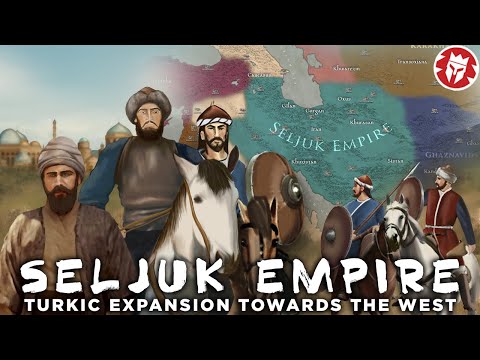
Seljuk Empire
The Seljuk Empire, or the Great Seljuk Empire, was a high medieval, Turko-Persian empire established and ruled by the Qïnïq branch of Oghuz Turks. The empire spanned a total area of 3.9 million square kilometres from Anatolia and the Levant in the west to the Hindu Kush in the east, and from Central Asia in the north to the Persian Gulf in the south, and it spanned the time period 1037–1308, though Seljuk rule beyond the Anatolian peninsula ended in 1194.
In 1153, the Oghuz Turks rebelled and captured Sanjar. He managed to escape after three years but died a year later. The Atabegs, such as the Zengids and Artuqids, were only nominally under the Seljuk Sultan, and generally controlled Syria independently. When Sanjar died in 1157, the empire fractured even further and rendered the Atabegs effectively independent. The breakaway states and dynasties included: After the Second Crusade, Nur ad-Din's general Shirkuh, who had established himself in Egypt on Fatimid land, was succeeded by Saladin. In time, Saladin rebelled against Nur ad-Din Zangi; upon his death, Saladin married his widow, captured most of Syria and created the Ayyubid dynasty.[citation needed] On other fronts, the Kingdom of Georgia began to become a regional power and extended its borders at the expense of the Great Seljuk Empire. The same was true during the revival of the Armenian Kingdom of Cilicia, under Leo II of Armenia, in Anatolia. The Abbasid caliph al-Nasir also began to reassert the authority of the caliph and allied himself with the Khwarezmshah Takash.[citation needed]
Founder of the dynasty
The founder of the dynasty was Seljuk, a warlord, who belonged to the Qiniq tribe of Oghuz Turks. He led his clan to the banks of the Syr Darya river, near city of Jend, where they converted to Islam in 985. Khwarezm, administered by the Ma'munids, was under the nominal control of the Samanid Empire. By 999, the Samanids had fallen to the Kara-Khanid Khanate in Transoxiana, while the Ghaznavids occupied the lands south of the Amu Darya. The Seljuks supported the last Samanid emir against the Kara-Khanids before establishing an independent base.
Expansion of the empire
The Oghuz Turks (also known as Turkmens at the time) were one of several groups of the Oghuz who made their way to Iran between about 1020 and 1040. They were led by Seljuk's son, Musa, and Musa's two nephews, Tughril and Chaghri. They first moved south to Transoxiana, and then to Khorasan, initially at the invitation of local rulers, then enmeshed in alliances and conflicts. Contemporary sources place them in Dehistan/Mishrian, Gyzylarbat, and Nisa, as well as Sarakhs, all in present-day Turkmenistan. Around 1034, Tughril and Chaghri were soundly defeated by the Oghuz Yabghu Ali Tegin and his allies, forcing them to escape from Transoxiana. Initially, the Seljuks took refuge in Khwarazm, which served as one of their traditional pastures, but they were also encouraged by the local Ghaznavid governor, Harun, who hoped to utilise the Seljuks for his efforts to seize Khorasan from his sovereign. When Harun was assassinated by Ghaznavid agents in 1035, they again had to flee, this time heading south across the Karakum Desert. First, they made their way to the important city of Merv, but perhaps due to its strong fortifications, they turned westwards to take refuge in Nisa. Finally, the Seljuks arrived on the edges of Khorasan, the province considered a jewel in the Ghaznavid crown.
Division of empire
When Malik-Shah I died in 1092, the empire split as his brother and four sons quarrelled over the apportioning of the empire among themselves. At the same time, the son of Suleiman ibn Qutalmish, Kilij Arslan I, escaped Malik-Shah I's imprisonment and claimed authority in the former lands of his father. In Persia, Malik-Shah I's four-year-old son Mahmud I was proclaimed sultan but his reign was contested by his three brothers Berkyaruq in Iraq, Muhammad I in Baghdad, and Ahmad Sanjar in Khorasan. Additionally, Malik-Shah I's brother Tutush I made a claim to the throne but was killed in battle against Berkyaruq in February 1096. Upon his death, his sons Radwan and Duqaq inherited Aleppo and Damascus respectively and contested with each other as well, further dividing Syria amongst emirs antagonistic towards each other.
First Crusade (1095–1099)
During the First Crusade, the fractured states of the Seljuks were generally more concerned with consolidating their own territories and gaining control of their neighbours than with cooperating against the crusaders. The Seljuks easily defeated the People's Crusade arriving in 1096, but they could not stop the progress of the army of the subsequent Princes' Crusade (First Crusade), which took important cities such as Nicaea (İznik), Iconium (Konya), Caesarea Mazaca (Kayseri), and Antioch (Antakya) on its march to Jerusalem (Al-Quds). In 1099, the crusaders finally captured the Holy Land and set up the first Crusader states. The Seljuks had already lost Jerusalem to the Fatimids, who had recaptured it in 1098 just before its capture by the crusaders.
Second Crusade (1147–1149)
During this time conflict with the Crusader states was also intermittent, and after the First Crusade increasingly independent atabegs would frequently ally with the Crusader states against other atabegs as they vied with each other for territory. At Mosul, Imad ad-Din Zengi succeeded Kerbogha as atabeg and successfully began the process of consolidating the atabegs of Syria. In 1144 Zengi captured Edessa, as the County of Edessa had allied itself with the Artuqids against him. This event triggered the launch of the Second Crusade. Nur ad-Din, one of Zengi's sons who succeeded him as atabeg of Aleppo, created an alliance in the region to oppose the Second Crusade, which landed in 1147.[citation needed]
Decline of the Seljuk Empire
Ahmad Sanjar fought to contain the revolts by the Kara-Khanids in Transoxiana, Ghurids in Afghanistan and Qarluks in modern Kyrgyzstan, as well as the nomadic invasion of the Qara-Khitais in the east. The advancing Qara-Khitais first defeated the Eastern Kara-Khanids, then followed up by crushing the Western Kara-Khanids, who were vassals of the Seljuks at Khujand. The Kara-Khanids turned to their Seljuk overlords for assistance, to which Sanjar responded by personally leading an army against the Qara-Khitai. However, Sanjar's army was decisively defeated by the host of Yelu Dashi at the Battle of Qatwan on 9 September 1141. While Sanjar managed to escape with his life, many of his close kin, including his wife, were taken captive in the battle's aftermath. As a result of Sanjar's failure to deal with the encroaching threat from the east, the Seljuk Empire lost all its eastern provinces up to the river Syr Darya, and vassalage of the Western Kara-Khanids was usurped by the Qara-Khitai, otherwise known as the Western Liao in Chinese historiography.
Seljuk power was indeed at its zenith under Malikshāh I, and both the Qarakhanids and Ghaznavids had to acknowledge the overlordship of the Seljuks. Seljuk dominion was established over the ancient Sasanian domains, in Iran and Iraq, and included Anatolia, Syria, as well as parts of Central Asia and modern Afghanistan. Their rule was modelled after the tribal organization common among Turkic and Mongol nomadic cultures, resembling a "family federation" or "appanage state". Under this organization, the leading member of the paramount family assigned to family members portions of his domains as autonomous appanages.
The Seljuks exercised full control over Islamic Central Asia and the Middle East between 1040 and 1157. For most of its history, the empire was split into a western and eastern half and did not have a single capital or political center. In the east, the chief seat of Seljuk rule was Marv in present-day Turkmenistan. In the west, various cities, where the Seljuk rulers lived periodically, served as capitals: Rayy, Isfahan, Baghdad, and, later, Hamadan. These western lands were known as the Sultanate of Iraq.[note 1] After 1118, the Seljuk rulers of Iraq recognized the suzerainty of the Seljuk sultan Ahmad Sanjar, who mostly ruled from Marv, and was known by the title of al-sultān al-a'zam, 'the Greatest Sultan'. The Seljuk rulers of Iraq were often mentioned as the "Lesser Seljuks".
Much of the ideological character of the Seljuk Empire was derived from the earlier Samanid and Ghaznavid kingdoms, which had in turn emerged from the Perso-Islamic imperial system of the Abbasid caliphate. This Perso-Islamic tradition was based on pre-Islamic Iranian ideas of kingship molded into an Islamic framework. Little of the public symbolism used by the Seljuks was Turkic, namely the tughra. The populace of the Seljuk Empire would have considered this Perso-Islamic tradition more significant than that of steppe customs. Highly Persianized in culture and language, the Seljuks also played an important role in the development of the Turko-Persian tradition, even exporting Persian culture to Anatolia.[b] Under the Seljuks, Persian was also used for books lecturing about politics in the mirrors for princes genre, such as the prominent Siyasatnama (Book of Politics) composed by Nizam al-Mulk. During this period, these types of books consciously made use of Islamic and Iranian traditions, such as an ideal government based on the Islamic prophet Muhammad and his successors, or the Sasanian King of Kings Khosrow I (r. 531–579).
In 985, the Seljuks migrated to the city of Jend, where they converted to Islam. The arrival of the Seljuk Turks into Persia, and their patronage of constructing madrasas, allowed for Sunni Islam to become the dominant sect of Islam. Until the death of Sultan Sanjar, the Seljuks were pious Sunnis and represented a re-establishment of Sunni Islam in Iraq and western Persia since the 10th century. In 1046, Tughril built the madrasa al-Sultaniya in Nishapur, while Chaghri Beg founded a madrasa in Merv. Tughril and Alp Arslan chose Hanafi qadis and preachers for these madrasas. By 1063, there were twenty-five madrasas scattered throughout Persia and Khorasan, founded by Seljuk princes. In the 12th century there were over thirty madrasas in Baghdad. In 1056, Tughril built a Friday mosque with a newly constructed quarter in Baghdad which was surrounded by a wall. The new quarter separated the Shia community from the Sunnis, since there had been frequent outbreaks of violence. Through the influence of Tughril's vizier, al-Kunduri, a Hanafi Sunni, the Ash'ari and Ismaili Shi'ites were exiled from Khurasan and cursed at Friday sermons in Seljuk mosques. Al-Kunduri's vizierate persecuted Ash'aris and Sharifis, although this ended with the vizierate of Nizam al-Mulk. It was under the vizierate of al-Kunduri that the Islamic scholar, Al-Juwayni was forced to flee to Mecca and Medina. In 1065, Alp Arslan campaigned against the Kingdom of Georgia, subjugated Tbilisi, and built a mosque in the city.
Control over the Abbasids in Iraq (1055–1135)
The region of Iraq was under the control of the Seljuk Empire from 1055 to 1135, since the Oghuz Turk Tughril Beg had expelled the Shiite Buyid dynasty. Tughril Beg entered Baghdad in 1055 and was the first Seljuk ruler to style himself Sultan and Protector of the Abbasid Caliphate. From that time, the Abbasids were only puppets in the hands of the Seljuks. In 1058, the Abbasid caliph granted Tughril the title of "King of East and West", officially becoming the temporal protector of Abbasid caliph Qa'im. Iraq remained under the control of the Great Seljuks during the reign of Muhammad I Tapar (1082–1118 CE), but from 1119, his 14-year-old son Mahmud II (1118–1131) was restricted ruling Iraq, while Ahmad Sanjar took control of the rest of the Empire.
General overview
The army of the earliest Seljuks was not similar to the renowned Turkic military of the classical Abbasid era. Their first invasions were more of a great nomadic migration accompanied by their families and livestock rather than planned military conquests. They were not a professional army; however, warfare was a way of life for nearly all of adult male Turkmens. According to a Seljuk vizier, Nizam al-Mulk, by the reign of Malik-Shah I, the sovereign had a large army at his disposal. There were Turkmens, mamluks, a standing army, infantry and the sultan's personal guard. Nizam al-Mulk also estimated Malik-Shah's forces at 400,000 men, and often opposed cost-cutting plans (instituted by Taj al-Mulk) to bring these to 70,000.
Turkmens
Vizier Nizam al-Mulk, the greatest advocate of Iranian orientation for the Seljuk empire, admitted the debt the dynasty owed to the Turkmens. After the establishment of the Seljuk state, Turkmens continued to be the driving force behind the Seljuk expansion in Anatolia. After the rule of Malik-Shah I, however, there are very few mentions of Turkmens in the Jibali region of the state, especially in their traditional axis of Rayy, Hamadhan and Hulwan. Turkmens were difficult to manage, and they were susceptible to undisciplined pillaging. The greatest issue, however, was their dependence on pasturelands for their livestock. A great number of regions that constituted the Seljuk state were ecologically ill-suited for supporting a nomadic army. Turkmens' limitations are adeptly described by Arab scholar Sibt ibn al-Jawzi:
Iqta' Army
This system, previously used by the ancient Islamic states, was established for military purposes during the Great Seljuk period during the reign of Sultan Malik-Shah I and gained a significant place in the military sphere. The army the Great Seljuks established using this system was called the Iqta' Army. The Ikta system, reorganized by Vizier Nizam al-Mulk, both trained soldiers and increased the prosperity of these lands. The Iqta' System underwent centralization movements during the Sanjar era. This army resembled the Timar Army of the Ottoman Empire.
Palace Ghilmans or Special Army
The Palace Ghilmans or Special Army, were an army troops paid by the state and tasked with protecting the imperial palace and the sultan during the Seljuk period. These troops also served as the Seljuk sultan's personal guard during battles and campaigns. For example, at the Battle of Manzikert, 4,000 ghilman formed the central army of the Seljuk Sultan Alp Arslan. Furthermore, these troops were of Sipahi origin.
Mamluks
The alternative to nomadic Turkmen troops was mamluks. While also of Turkic and often nomadic origin, dependence on pasturelands was non-existent for mamluks, as they did not live a nomadic life. Previously, mamluks had constituted the later Abbasid, the Samanid, and the Ghaznavid armies. In fact, the Ghaznavid dynasty was itself of Mamluk origin. The process of Mamluk recruitment is well known from other periods in Islamic history, but there is almost no information directly relating to the Seljuks. The chief source of Mamluks was most probably forays to the steppe. The alternative to raids was buying them from slave traders and various dealers as evidenced from a slave dispute between a merchant and Muhammad I Tapar.
Military of successor states
Many depictions of military figures are known from the period immediately following the Seljuk Empire (which ended in 1194), as illustrated manuscripts started to enjoy a major boom from circa 1200. Seljuk styles of military equipment continued during the 13th century in the Turkic post-Seljuk successor states (generally included under the term "Seljuk period"), such as the Seljuk Rums, the Zengids, the Artuqids or the Khwarizmians, and are documented in their manuscripts.
Mosques and madrasas were created and embellished during the period of Seljuk control. Congregational mosques were either repaired, rebuilt, or constructed in their entirety. The Seljuk sultan also commissioned numerous madrasas to promote the teaching of orthodox Islamic sciences. These developments in architectural practice are coherent with the Seljuk dynasty's focus on Islam and the promotion of Muslim orthodoxy, the combining of Sufism and Sunnism. Overall, the architecture attributed to the Seljuk period is characterized by elaborate decoration, much like the other arts produced under Seljuk rule. Decoration was primarily executed in elaborate brickwork and in the use of colorful glazed tiles. The most important innovations of this period occurred in the form of mosques, as first seen in the renovations of the Friday mosque of Isfahan. One was the introduction of the four-iwan plan. This was attested in some earlier buildings, but under the Seljuks it turned into a common characteristic of mosques, madrasas, and caravanserais in Iran and Central Asia, eventually influencing architecture in Syria, Mesopotamia, and Anatolia as well. Another major innovation was the creation of monumental domes over the space in front of the mihrab (or the maqsura), which also became characteristic of later mosques in this region and beyond.
Various art forms were popularized during the Seljuk period, as evidenced by the vast amount of surviving artifacts. Most Seljuk arts are known to have been produced in what is modern-day Iran. However, the Seljuk sultans also encouraged artists to settle in Anatolia as part of a recolonization and reconstruction process in several cities. Many works of Seljuk art continued to be produced following the decline of the empire in the late 12th century. In this regard, the timeline associated with the production of Seljuk art does not entirely match the political events pertaining to the empire and its eventual fall. Nonetheless, relatively little art can be correctly dated and ascribed to a Great Seljuk context. Much of the material deemed to be Seljuk in world museums in fact belongs to the period A.D. 1150–1250, after the fall of the Great Seljuk Empire, when there seems to have been a sudden burst in artistic production, apparently to a great extent unrelated to court patronage.
Ceramics
Among other ceramics, the manufacture of polychrome ceramic tiles, often used as decor in architecture, were popularized during the Seljuk dynasty. The Seljuks pioneered the use of the Mina'i technique, a painted and enameled polychrome overglaze for ceramics. The glazes on the Seljuk ceramics produced often ranged from a brilliant turquoise to a very dark blue. The art of Seljuk mosaic tile decorating would continue to dominate the interior of many Anatolian mosques following the period of Seljuk rule. The Seljuks also created ceramic house models, while other ceramic forms in the Seljuk period included pottery figurines, some of them children's toys.
Art of the book
Both secular and non-secular manuscripts were produced during the Seljuk period. These pieces are now limited in availability, considering their ultimate susceptibility to damage over time. But those manuscripts that have survived over the centuries provide insight into the Seljuks' involvement in the arts of the book. Calligraphers and illuminators were responsible for the creation of these manuscripts, though sometimes calligraphers mastered the art of both writing and illustration. By the end of the 10th century, both illuminators and calligraphers were beginning to employ various colors, styles, and writing techniques in the realm of the book arts.
Metalwork
Starting around the middle of the 12th century, there appears to have been a major increase in the number of artistic metalwork objects produced in the eastern Islamic world (roughly Iran and Central Asia). More of these objects have survived from after the 1140s than from before this period. The major centers of production were initially concentrated in the Khorasan region, including Nishapur, Herat, and Ghazna. There is some scholarly debate about the patronage of these objects, with some suggesting that the growth in production is explainable by the growth of a bourgeoisie in Khorasan which had the means to afford such costly craftsmanship. This is attested in part by inscriptions naming merchant owners, but most surviving objects are nonetheless attributed by their inscriptions to sultans, royal household members, or state officials. In the early 13th century, this expansion of metalwork art and patronage also occurred further west, in the Levant and Mesopotamia, under the successors of the Great Seljuks (the Zengids, the Artuqids, and the Anatolian Seljuks), spurred in part by the immigration of metalworkers from Iran.
Textiles and clothing
The general clothing style attributed to the Seljuks is that of the aqbiya tatariyya, or long robe or decorated caftan with a "Turkish" cut, with a front opening closing diagonally from right to left. Patterned textiles were used, together with tiraz bands on the upper sleeves. Clothing included tall boots, as well as various hats of the sharbush type, often including a fur lining. These styles continued during the 13th century in the smaller Turkic successor states, such as the Zengids or Artuqids, where many more illustrations are available, especially in manuscripts. On the other hand, the affluent sedentary Persian population seems to have adopted different robe styles, with a front opening closing diagonally from left to right, called the aqbiya tatariyya or "Tatar style", but actually also characteristic of Persian caftans from the last decades of the Sasanian dynasty. The fabrics represent what could be called a "Sasanian renaissance", with styles going back to the Sasanian or Sogdian period. Seljuk fabrics are often distinguished by the representation of nature, by minimal ornamental details, and by the combination of colorful linens giving an interchangeable color effect to the fabric. Many realistic natural elements characterize the composition of the fabrics, such as animals and plants, forming patterns consisting of arabesque elements.
The dynasty brought revival, energy, and reunion to the Islamic civilization hitherto dominated by Arabs and Persians. The Seljuks founded universities and were also patrons of art and literature. Their reign is characterized by Persian astronomers such as Omar Khayyam, and the Persian philosopher al-Ghazali. Under the Seljuks, New Persian became the language for historical recording, while the center of Arabic language culture shifted from Baghdad to Cairo.