Hardtack
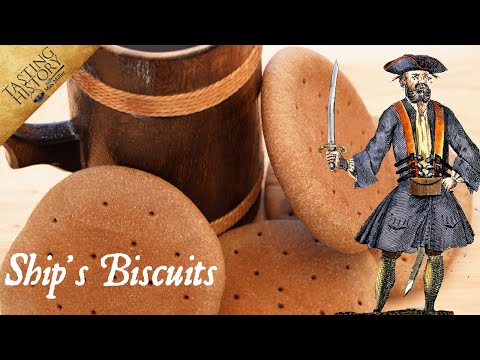
Hardtack is a type of dense cracker made from flour and small amounts of water, with salt being sometimes added. Hardtack is very inexpensive and long-lasting if kept dry, allowing it to be used for sustenance in the absence of perishable foods. It is commonly used during long sea voyages, land migrations, and military campaigns. Along with salt pork and corned beef, hardtack was a standard ration for many militaries and navies from the 17th to the early 20th centuries.
The name is derived from "tack", the British sailor slang for food. The earliest use of the term recorded by the Oxford English Dictionary is from 1830. It is known by other names including brewis (possibly a cognate with "brose"), cabin bread, pilot bread, sea biscuit, soda crackers, sea bread (as rations for sailors), ship's biscuit, and pejoratively as dog biscuits, molar breakers, sheet iron, tooth dullers, weevil hardtack, Panzerplatten ("armor plates"; Germany) and worm castles. Australian and New Zealand military personnel knew them with some sarcasm as ANZAC wafers (not to be confused with Anzac biscuit).
The introduction of the baking of processed cereals, including the creation of flour, provided a more reliable source of food. Egyptian sailors carried a flat brittle loaf of millet bread called dhourra cake. A cracker called bucellatum is known from Ancient Rome. King Richard I of England left for the Third Crusade (1189–1192) with "biskit of muslin", which was a mixed grain compound of barley, bean flour, and rye. The more refined captain's biscuit was made with finer flour. Some 5th century BCE physicians, such as Hippocrates, associated most medical problems with digestion. For sustenance and health, eating a biscuit daily was considered good for one's constitution. Because hardtack biscuits were baked hard, they would stay intact for years if kept dry. For long voyages, hardtack was baked four times, rather than the more common two, and prepared six months before sailing. Because it is dry and hard, hardtack, when properly stored and transported, will survive rough handling and temperature extremes. Dry hardtack is dense and virtually inedible; troops issued it usually made it edible by dampening or crushing the biscuits.
Cocket bread
Cocket bread was a type of bread in England, as referenced in the Assize of Bread and Ale (temp. incert.) (c. 1266), where it is one of several kinds of bread named. It seems to have been hard sea-biscuit, which perhaps had then some mark or seal (a cocket) on it; or else, was so called from its being designed for the use of the coxswains, or seamen.
Commercially available hardtack is a significant source of food energy in a small, durable package. A store-bought 24-gram cracker can contain 100 calories (20 percent from fat) and 2 grams of protein. [citation needed]
Asia
Ma Bo mentioned hardtack as being a staple food of Chinese hard-labor workers in Inner Mongolia, during the Cultural Revolution. Hardtack was a staple of military servicemen in Japan and South Korea well into the late 20th century. It is known as Kanpan (乾パン) in Japan and geonbbang (geonppang, 건빵) in South Korea, meaning 'dry bread', and is still sold as a fairly popular snack food in both countries. (Canned kanpan is also distributed in Japan as emergency rations in case of earthquake, flood, or other disaster.) A harder hardtack than Kanpan, called Katapan (堅パン), is historically popular in Kitakyushu, Fukuoka, Japan as one of its regional specialty foods. In Korea, geonppang (hardtacks) mixed with byulsatang (star candy) as a medley is considered a popular snack.[citation needed]
Europe
Hardtack, baked with or without the addition of fat, was and still is a staple in Russian military rations, especially in the Navy, as infantry traditionally preferred simple dried bread when long shelf life was needed. Called galeta (галета) in Russian, it is usually somewhat softer and more crumbly than traditional hardtack, as most varieties made in Russia include at least some fat or shortening, making them closer to saltine crackers. One such variety, khlyebtsy armyeyskiye (хлебцы армейские), or "army crackers", is included in Russian military rations. Other brands enjoy significant popularity among the civilian population as well, both among campers and the general populace.
North America
Hardtack is a mainstay in parts of Canada. Purity Factories is one maker of traditional hardtack. They specialize in a high density, high caloric product that is well suited for use by expeditions. Located in St. John's, Newfoundland and Labrador, they currently produce three varieties of hardtack: Interbake Foods of Richmond, Virginia, produces most of the commercially available hardtack in the United States, under the "Sailor Boy" label. As of January 2015, 98 percent of its production goes to Alaska. Alaskans are among the last to still eat hardtack as a significant part of their normal diet. Originally imported as a food product that could endure the rigors of transportation throughout Alaska, hardtack has remained a favored food even as other, less robust foods have become more readily available.