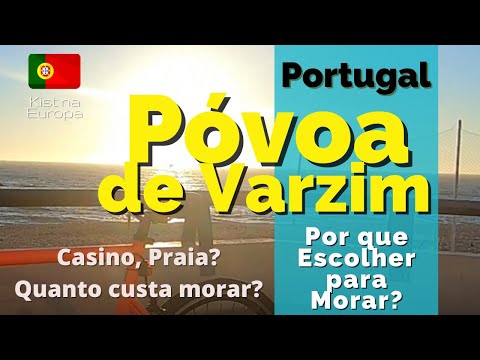
Póvoa de Varzim
Póvoa de Varzim is a Portuguese city in Northern Portugal and sub-region of Greater Porto, 30 km (18.6 mi) from its city centre. It sits in a sandy coastal plain, a cuspate foreland, halfway between the Minho and Douro rivers. In 2001, there were 63,470 inhabitants, with 42,396 living in the city proper. The city expanded southwards, to Vila do Conde, and there are about 100,000 inhabitants in the urban area alone. It is the seventh-largest urban agglomeration in Portugal and the third largest in Northern Portugal.
Imagem: Portuguese_eyes · BY-SA · Openverse
Castro Culture and Roman conquest
Discoveries of Acheulean stone tools suggest Póvoa de Varzim has been inhabited since the Lower Palaeolithic, around 200,000 BC. The first groups of shepherds settled on the coast where Póvoa de Varzim is now located between the 4th millennium and early 2nd millennium BC. A Neolithic-Calcolithic necropolis, with seven known burial mounds, can still be seen around São Félix Hill and Cividade Hill. Widespread pillaging by rival and migrant tribes led the resident populations of the coastal plain of Póvoa de Varzim to raise a town atop the hill that stood next to the sea. The acropolis protection was reinforced by successive rings of walls and a trench at the base of the hill. Established by the 9th or 8th century B.C., the city area covered 12,000 m2 (3.0 acres) and had several hundred inhabitants. Its location near waterways helped it to maintain commercial relations with the Mediterranean civilizations, especially noticeable during the Carthaginian dominion of the southern Iberian Peninsula.
Feudalism and municipalism
With the fall of the Roman Empire, Suebi populations established themselves in the countryside. It was first mentioned on 26 March 953 during the rule of Mumadona Dias, Countess of Portugal. The region was attacked by the Vikings in the 960s, by the Moors in 997 and again by Norman pirates in 1015–1016. Hints indicate a Norse settlement in Villa Euracini after those invasions. During the Middle Ages, the name Euracini evolved to Uracini, Vracini, Veracini, Verazini, Verazim, Varazim and, eventually, Varzim. In 1033, Guterre Pelayo, a leading captain of the Reconquista for the County of Portugal, was recognized by Bermudo, Emperor in Gallaecia, as the Lord of Varzim, during the chaotic epoch following Almanzor's attack on the Christian realms. Henry, the Portuguese count, recognized his rule over the port of Varzim amongst several other possessions. Varzim overlords gained significant power and, when Portugal was already a stable kingdom, Sancho I of Portugal attacked the fief and seized the port, destroyed most of the properties and expelled the farmers. The northern area became known as Varzim dos Cavaleiros (Knights' Varzim) and belonged to the military order of the Knights Hospitaller, who inherited the wealth of the local overlords. Lower Varzim, the royal southern land, was the location of the port and contiguous farmlands.
Shipbuilders, seafarers and fishermen
In the 16th century, the fishermen started to work in maritime activities, as pilots or seafarers in the crew of the Portuguese ships, due to their high nautical knowledge. The fishermen of the region are known to fish in Newfoundland since at least 1506. During the reign of John III the Povoan shipmaking art was already renowned, and Povoan carpenters were sought after by Lisbon's Ribeira das Naus shipyard due to their high technical skills. The single-floored houses dominated the town's landscape, but there are indications of multiple floored habitations with rich architecture. The seafarers' social class, well-off gentlemen, was associated with this richer architecture around Praça Velha square.
The Baths of Póvoa and the modern city
Since 1725, the iodine-rich seawaters of Póvoa, due to the peculiar high quantities of seaweed that ends up in Póvoa beaches from the sheltered bay to Cape Santo André, brought by ocean currents, lead that Benedictine monks choose to take sea-baths in there, searching cures for skin and bone problems. Still in the 18th century, other people went to Póvoa with the same concerns. In the 19th century, the town became popular as a summer destination for the wealthy of Entre-Douro-e-Minho province and Portuguese Brazilians, due to its large sandy beaches and the development of theaters, hotels and casinos. It then became renowned for its refined literary culture, artistic patronage in music and theater, and intellectual tertulia.
Imagem: PedroPVZ · BY-SA · Openverse
Occupying an area of 82.1 km2 (31.7 sq mi), Póvoa de Varzim lies between the Cávado and Ave rivers, or, from a wider perspective, halfway between the Minho and Douro rivers on the northern coast of Portugal — the Costa Verde. It is bordered to the north by the municipality of Esposende, to the northeast by Barcelos, to the east by Vila Nova de Famalicão, and to the south by Vila do Conde. To the west, it has a shoreline on the Atlantic Ocean. The rocky cliffs, common features downstream of the Minho's estuary, disappear in Póvoa de Varzim, giving way to a coastal plain. The plain is located in a cuspate foreland, an old marine plateau from the Plio-Pleistocene, conferring a sandy soil to the coastal lands. The sand dunes in the Northwestern coast formed during the Little Ice Age and started piling up in the 15th or 16th century. Wandering along the coast one discerns Cape Santo André, the tip of the cuspate foreland and the Avarus Promontory, referred to by Ptolemy.
Climate
Póvoa's climate is classified as a Warm-summer Mediterranean climate (Csb in the Köppen climate classification system), with gentle summers and mild winters, influenced by the Atlantic Ocean. Temperature extremes recorded at Sá Carneiro Airport, records started in 1967, range from −3.8 to 38.3 °C (25.2 to 100.9 °F). In Póvoa de Varzim proper, average temperatures oscillate between 9 °C (48.2 °F) in winter and 19 °C (66.2 °F) in the summer. The city's beach area averages between 11 and 18 °C (51.8 and 64.4 °F) and diurnal temperature variation there is very low, just 4 °C (39.2 °F). The remaining territory, including the northwestern rural beaches, swings around 8 °C (46.4 °F) daily. Using 1971–2000 data, there are 33 days a year above 25 °C (77.0 °F) and 9 days above 30 °C (86.0 °F). Heat waves can occur for an average of 10 days, yet it tends to be balmier than inland Northwestern Portugal, and it is used by inland Minho Province residents seeking to escape the summer heat in the valleys. The so-called tropical nights with minimum temperature above 20 °C (68 °F) occur three days per year.
Imagem: Contando Estrelas · BY-SA · Openverse
A native of Póvoa de Varzim is called a Poveiro which can be rendered into English as Povoan. According to the 2001 Census, there were 63,470 inhabitants that year, 38 848 (61.2%) of whom lived in the city. The number goes up to 100,000 if adjacent satellite areas are taken into account, ranking it as the seventh largest independent urban area in Portugal, within a polycentric agglomeration of about 3 million people, ranging from Braga to Porto. According to the EOCD methology, Póvoa de Varzim was the 13th largest Functional urban area of Portugal, hence a small urban area with 63,428 inhabitants, by including only its municipality. The urban area has a population density of 3,035 people/km2 (7,860 people/mi2), while the rural and suburban areas have a density of 355.5/km2 (921/mi2). The rural areas away from the city tend to be scarcely populated, becoming denser near it. During the summer the resident population in the city triples; this seasonal movement from neighbouring cities is due to the draw of the beach and 29.9% of homes had seasonal use in 2001, the highest in Greater Porto. Póvoa de Varzim is the youngest city in the region with a birth rate of 13.665 and mortality rate of 8.330. Unlike other urban areas of greater Porto, it is not a satellite city. Significant commuting occurs only with Vila do Conde, an urban expansion area of Póvoa since the 18th century.
Imagem: Portuguese_eyes · BY-SA · Openverse
The economy of Póvoa de Varzim is driven by sales, manufacturing, construction, healthcare, agribusiness, fishing, and tourism. In the 2021 census, the unemployment rate, at 8.3%, compared to Porto Metropolitan Area at 9.6%, Northern Portugal at 8.4% and the national average at 8.1%. Póvoa de Varzim's purchasing power represented 0.6% of the total national purchasing power in 2019, up from 0.5% in 1993. However, per capita values were just 96.5% of the national average in 2019, up from 90.6% in 1993. Comparing 2009 to 2020, the diversified economy of Póvoa de Varzim drifted away from construction (-70.3%), administrative (-55.6%), Entertainment & leisure (-44.1%), and professional services (-22.9%) towards the growing fields of real estate (+73.5%), industrial sector (+47.3%), sales (+43.4%), Agribusiness & Fisheries (+41%), Healthcare (+31.9%) and Hospitality (+9.2%). quaternary sector (+41%) and Transport (+9.4%) are comparably minor yet growing economic activities.
Fisheries
The fact that it is a seaside city has shaped Póvoa de Varzim's economy: the fishing industry, from the fishing vessels that put in each day to the canning industry and to the city's fish market, beach agriculture, and seaweed-gathering for fertilizing fields are the result of its geography. Tourism and the related industries are more relevant in Póvoa's economy these days, as fisheries have lost importance. Nevertheless, the mean value of fish landed in 2004, in its seaport, was almost three times that of Matosinhos seaport and significantly higher in the average vessels' capacity. Its fishing productivity is also comparatively higher than the national average. A Poveira is a traditional Povoan canning factory and most of its production, 80 to 85%, is exported and deals with high-end brands in canned fish, for MDC markets. Export market brands include: Poveira, D'Henry IV, Ala-Arriba, Minerva, and Alva.
Agribusiness
Production is still specialized in horticultural goods, but most of the masseiras were substituted by greenhouses and a significant share of the production is exported to other Western European markets. Póvoa de Varzim is part of the ancient Vinho Verde winemaking region, and there is commercial wine production, however, local masseira wines are not commercially produced. The inland valley region is committed to milk production and the Agros corporation headquarters of Lactogal, the largest dairy products and milk producer company in the Iberian Peninsula, is located in Espaço Agros and has several departments such as exhibition park and laboratories. In agriculture, the masseira farm fields were developed. This technique increases agricultural yields by using large, rectangular depressions dug into sand dunes, with the spoil piled up into banks surrounding the depression. Grapes are cultivated on the banks to the south, east and west, and trees and reeds on the northern slope act as a windbreak against the prevailing northern wind. Garden crops are grown in the central depression.
Tourism
Tourism industry is subdivided into gambling, hospitality, restaurants, beach bars and cafés. National visitors are prevalent and from diverse localities. In 1876, Ramalho Ortigão noticed that Póvoa was very popular in all social ranks in Northern Portugal. In the contemporary period, the construction of motorways negatively affected overnight stays in local hotels. This has been leveled by a noticeable attraction of Portuguese living abroad and foreign tourists and the number of hotel rooms in 2014 increased to 1.774. Most of those tourists are French or from diverse countries in Northern Europe. International tourists sleeping in the city's hotels represented 35.1% of guests in 2013, up from 30.3% in 2001. In 2017, international tourists represented 55% of guests in the hospitality industry, which registed 250 thousand overnight stays almost the double of the 2012 statistics. Informal local accommodation, especially typical homes in rua Latino Coelho, is a popular alternative. In the summer of 2017, Póvoa de Varzim was the second location with the largest growth in the Portuguese AirBNB hospitality service. Póvoa de Varzim has the longest overnight stays for foreign tourists in Metropolitan Porto who stay, on average, 3 days.
Manufacturing
There are some industrial areas, including Zona Industrial de Amorim and Parque Industrial de Laundos, in the city's outskirts, next to the A28 Motorway. Póvoa de Varzim has been noted internationally for its Renewable energy industry. The world's first commercial wave farm was located in its coast, at the Aguçadora Wave Park. The wave farm used Pelamis P-750 machines. The project failed and was replaced by the windfloat project, a new prototype on offshore wind farms, from a distinct company, that attained successful testing. Energie, a company headquartered in Póvoa de Varzim, developed a thermodynamic solar system combining solar energy and a heat pump to generate energy.
Imagem: amaianos · BY · Openverse
Póvoa de Varzim is governed by a Câmara Municipal (City Council) composed of nine councilmen. A Municipal Assembly exists and it is the legislative body of the municipality. After the first free elections, with the end of the Estado Novo period, only right-wing parties have governed the city: the city council was governed by the CDS between 1976 and 1989 and since then by the PSD. The CDS saw its popularity suffer an abrupt decline in 1997. On the other hand, the PSD in the same year achieved its first absolute majority with 62.4% of the votes. After the 2021 municipal elections, seven councilmen were members of the centre-right Partido Social Democrata (PSD), and two of the centre-left Partido Socialista (PS). The current mayor is Andrea Silva, for the PSD, elected with 40.6% of the votes, under a 58% turnout. The PSD holds a minority in the Municipal Assembly, but a majority in the administrative parishes. Póvoa de Varzim Assembly is singly elected and comprises 27 members, with the PSD holding 11 seats — 36.84%, the PS 9 seats — 29.15%, Chega 5 seats — 17.85%, the Liberals 1 seat — 5.26%, and the CDS 1 seat — 3.78%.
Imagem: Portuguese_eyes · BY-SA · Openverse
Urban morphology
Located in the coastal plain between the sea and hills, the city of Póvoa de Varzim has eleven Partes (parts), or districts. These districts are, in turn, part of two formal administrative structures known as freguesias (civil parishes): U.F. Póvoa de Varzim, Beiriz e Argivai and U.F. Aver-o-Mar, Amorim e Terroso. To the south, the city is extending out to combine with Vila do Conde. The city started from an inland town that extended to the coast. The Bairro da Matriz, whose nucleus was the centre from whence the city grew, is intersected by 14th century narrow and twisted streets lined by single-family homes. The historical district has old buildings such as the sixteenth-century house in front of Matriz Church — the main church, the old Town Hall (14th century), the seventeenth-century Solar dos Carneiros and the house of Captain Leite Ferreira, and the eighteenth century Limas and the Coentrão Houses. The fishermen were grouped in the south coast, around Póvoa Cove (Enseada da Póvoa); The fisher district was already developed in the 18th century with its structure of narrow streets parallel to the coast.
Beaches and parks
Póvoa de Varzim's beach is a 12 km (7.5 mi) stretch of golden sands, forming sheltered bays and divided by rocks. Most beaches in the city are family-oriented such as Redonda, Salgueira or Lagoa Beach and during the summer period it can get crowded while those away from the city core, such as Santo André, are less crowded. Salgueira and Aguçadoura are surfing beaches. Located near a camping park, Rio Alto Beach is chosen by naturists given its difficult access and the privacy offered by the sand dunes. The most important and popular green space is Póvoa de Varzim City Park, an urban park hosting leisure activities. It is almost entirely landscaped including hills, a large island, a lake, ponds and a stream. The city park and other minor parks in Póvoa de Varzim were designed by Sidónio Pardal, a well-known Portuguese landscape architect. It also includes great lawn areas, rustic buildings, amphitheatres and playground structures. It is a popular place for jogging, cycling and birdwatching. It stretches from the A28 motorway to Pedreira Lake.
Countryside
The green belt of Póvoa de Varzim includes a web of 98 localities in the parishes of Aguçadoura, Amorim, Balazar, Beiriz, Estela, Laundos, Navais, Rates, and Terroso. São Pedro de Rates, Codixeira, Aldeia, Pedreira, Fontainhas, Areosa, Teso, and Santo André de Baixo are the main rural communities, but there are tiny villages, such as Além, Calves, Gestrins, Gresufes, Passô, Sejães, and Crasto. Terroso, Amorim and Beiriz are located in the urban hinterland. Beiriz has the notorious Beiriz carpets and diverse old country estates such as villas and a tapada, a hunting park, while Amorim is known for the bread eaten at high temperatures just after being made — the Broa de Amorim. The hills of Póvoa de Varzim: Cividade and São Félix are located in Terroso and Laúndos, respectively. On the first hill, there is Cividade de Terroso, with 3 thousand years was one of the major Castro culture cities, and the eremite Saint Félix is thought to have lived on the second hill during the Middle Ages.
Imagem: Portuguese_eyes · BY-SA · Openverse
Junqueira is Póvoa de Varzim's busiest shopping district, that cater to both the daily needs of residents and visitors. The main street, a shopping street since the 18th century, is a pedestrian area since 1955, one of the earliest in Portugal, and a model for other Portuguese cities that later did similar developments. It has about 1 km (0.62 mi) of pedestrian streets. Dotted with boutiques in old traditional buildings, Junqueira is renowned for its jewellery, with Ourivesaria Gomes was the goldsmith, The most notable of its goldsmiths is Ourivesaria Gomes, where, during the Estado Novo, important people of the regime were often seen with their families. Open for more than 100 years, Ourivesaria Gomes was the goldsmithery of the Portuguese Royal House, and it had kings, nobility and the clergy as customers. The bullet used for the assassination attempt of Pope John Paul II was encrusted in the crown of Our Lady of Fatima by them.
Entertainment and performing arts
Casino da Póvoa is a gaming and entertainment venue since the 1930s. In 2006, it was the second casino in revenues, with 54 million euros and the third most popular with 1.2 million customers. The casino has several bars, a live performances bar, a theater and restaurants, including haute cuisine of local and Portuguese inspiration. In the 19th century, Póvoa had over a dozen gambling venues, such as Salão Chinês, Café Suisso, Café David, Café Universal and Luso-Brasileiro. Póvoa de Varzim has hotels. The most historic of which is the Grande Hotel da Póvoa, built in the 1930s, an arresting modernist building and, siding it, the Hotel Luso-Brasileiro, the oldest in town, running since the 19th century, other 19th-century former hotels are found in the city such as Hotel Universal in Praça do Almada.
Museums
The Ethnography and History Municipal Museum of Póvoa de Varzim (1937) on Rua Visconde de Azevedo houses archaeological finds and exhibits relating to the seafaring history of the city. it is one of the oldest ethnic museums in Portugal and the "Siglas Poveiras" exhibit won the 1980 "European Museum of The Year Award". It possesses ancient sacred art, Poveiro boats and archaeological finds such as Roman inscriptions and Castro culture pottery. Themed museums exist: Santa Casa Museum with a religious theme, the Museum Nucleus of the Romanesque Church of Saint Peter of Rates, the Archaeological Nucleus of Cividade de Terroso, and the Bullfighting Museum located in Póvoa de Varzim bullring. Another two museums are due to open: Casa do Pescador (Fisherman home) and Farol de Regufe (Regufe lighthouse).
Ethnography
The culture of Póvoa de Varzim derives from different working classes and with influences arriving from the maritime route from the Baltic Sea to the Mediterranean. The docudrama film Ala-Arriba! by José Leitão de Barros, popularized this unique Portuguese fishing community within the country during the 1940s. The local expression ala-arriba means "go upwards" and it represents the co-operation between the inhabitants. Siglas Poveiras are a form of proto-writing system, with a restricted number of symbols that were combined to form more complex symbols; these were used as a rudimentary visual communication system, and as a signature to mark belongings. Merchants wrote them in their books of credit; fishermen used it in religious rituals by marking them in the door of Catholic chapels near hills or beaches; in the table of the church during marriage and in their tombstone; and also had magical significance, such as the São Selimão sigla, that could be used as a protecting symbol and not as family mark. Children used the same family mark with piques as a form of cadency. The youngest son would not have any pique and would inherit his father's symbol. The siglas are still used, though much less commonly, by some families; and are related with Viking traditions.
Cuisine
The most traditional ingredients of the local cuisine are locally grown vegetables and fish. The fish used in the traditional cuisine are divided in two categories, the "poor" fish (sardine, ray, mackerel, and others) and the "wealthy" fish (such as whiting, snook, and alfonsino). The most famous local dish is Pescada à Poveira (Poveira Whiting), whose main ingredients are, along with the fish that gives the name to the dish, potatoes, eggs and a boiled onion and tomato sauce. Other fishery dishes include the Arroz de Sardinha (sardine rice), Caldeirada de Peixe (fish stew), Lulas Recheadas à Poveiro (Poveiro stuffed squids), Arroz de Marisco (seafood rice) and Lagosta Suada (steamed spiny lobster). Shellfish and boiled iscas, pataniscas, and bolinhos de bacalhau are popular snacks. Other dishes include Feijoada Poveira, made with white beans and served with dry rice (arroz seco); and Francesinha Poveira made in long bread that first appeared in 1962 as fast food for holidaymakers.
Sports
The city has developed a number of sporting venues and has hosted several national, European and world championships in different sports. 38% of the population practised sport, a high rate when compared to the national average. Several sports venues are located in the Northside around Avenida Vasco da Gama. The most popular sport in Póvoa de Varzim is association football. The city is home to Varzim SC, a professional football club, who play in Estádio do Varzim on the North Side. City Park's Stadium and surrounding football fields are the main stage for Póvoa de Varzim's People's championship where its junior and senior football clubs compete: Aguçadoura, Amorim, Argivai, Averomar, Balazar, Barreiros, Beiriz, Belém, Estela, Juve Norte, Laundos, Leões da Lapa, Mariadeira, Matriz, Navais, Rates, Regufe, Terroso, and Unidos ao Varzim.
Media
O Comércio da Póvoa de Varzim (est. 1903), A Voz da Póvoa (est. 1938), and Póvoa Semanário, which appeared during the 1990s, are Póvoa de Varzim's major weekly newspapers; while the Gazeta da Póvoa de Varzim (1870–1874) was the first local newspaper. Most are dedicated to local news and have Internet editions. The local radio stations Rádio Mar (89.0) and Radio Onda Viva (96.1) broadcast on FM and online. The stations' programming include local news and sports and feature an in-depth look at the city's top news by interviewing a guest at lunchtime on weekends. Radio Onda Viva airs Mandarin Chinese programming daily. The radio station, Rádio Mar, and the newspaper Póvoa Semanário belong to the same group; the same company offers news services to the neighbouring cities of Vila do Conde and Esposende.
Imagem: Portuguese_eyes · BY-SA · Openverse
Education
Higher education in the region has a dynamic history and growing availability. The Póvoa de Varzim/Vila do Conde campus, also known as Campus 2 of the Technical University of Porto (Universidade Técnica do Porto), houses the Superior School of Hospitality and Tourism — which maintains its polytechnic nature — and the Faculty of Media, Arts and Design. The latter faculty is centered around creativity and employability, offering academic choices focused on design, cinema, photography, multimedia, and the Web. Campus 2 was built in 2001, spanning 31,544 square metres (7.795 acres) with state-of-the-art facilities such as three amphitheaters, a large library, an auditorium, and a research space.
Healthcare
The first healthcare structure, the Santa Casa da Misericórdia da Póvoa de Varzim (Holy House of Mercy), opened in 1756. The hospitals of the city are the São Pedro Pescador Hospital (state-run) in Largo das Dores and the privately held Hospital da Luz Póvoa de Varzim (notable private hospital previously known as Clipóvoa) in Rua Manuel I street. The public hospital suffers from a lack of bed spaces. Due to this, it underwent expansion works and there is an ongoing plan to build a modern hospital on the border between the cities of Póvoa de Varzim and Vila do Conde, to serve the population of both municipalities. The Centro de Saúde da Póvoa de Varzim (Health Centre) is a public primary care building that has extensions in the main suburbs.
Public safety
The Municipal Police of Póvoa de Varzim is an administrative police force that acts solely within the municipality and reports directly to the mayor and it is headquartered in the former Póvoa de Varzim Barracks, the Quartel, in Rua Rocha Peixoto. The Polícia de Segurança Pública (PSP) does the city policing and it is headquartered in the Esquadra, police station located in Praça Marquês de Pombal, while the Guarda Nacional Republicana (GNR) is responsible for the countryside and its territorial station or Posto Territorial da Póvoa de Varzim is located in Largo das Dores. Póvoa de Varzim had a crime rate of 27.1 per 1,000 residents in 2015, ranking among the safest municipalities in metropolitan Porto. It is considered by the PSP police as a "calm" zone in all categories of offense; violent crime, in particular, is practically non-existent. Mostly, crime consists of minor robberies to homes, stores, or from cars.
Imagem: Portuguese_eyes · BY-SA · Openverse
Póvoa de Varzim has a transportation system that includes travel by sea, air, and land. On land, the city is connected by motorways, highways, and the Porto Metro. These transport options, along with the airport, bus station, marina, and harbour, are used daily by locals and visitors. Public transport in the city is run by private companies. The Central de Camionagem bus station is a hub for city and long-distance buses, offering connections to nearby rural areas, Porto, the Minho region, and Galicia in Spain. Litoral Norte operates an urban bus network with five routes, while Linhares, the city’s oldest bus company, is now owned by Transdev. Taxis in Póvoa de Varzim are black with an olive-green roof. The main taxi stands are in Praça do Almada, near the metro station, and at Largo das Dores. Taxi services, including Central Táxis Ribamar and Táxis Póvoa, also offer tours to attractions outside the city, such as the Discovery Age ship replica in Vila do Conde, the medieval churches of Rates and Rio Mau, the ancient settlement of Cividade de Terroso, and São Félix Hill.
Air
The Francisco Sá Carneiro Airport (IATA: OPO, ICAO: LPPR) is located 18 km (11 mi) south of Póvoa de Varzim. The airport, known outside the region as Porto Airport, is the second-busiest international airport in Portugal, moving over 10.7 million passengers in 2017. Using cars or taxis, it is fast accessible (17 minutes) via the A28 motorway, linked to the A41 motorway and the airport's drop-off and pick-up areas, or the EN13 highway, the later using the airport's EN107 accessway. Póvoa Aerodrome, officially known as S. Miguel de Laundos, is small-sized, with only 270 meters long for ultralight aviation and other small planes for leisure activities.
Rail
Line B of the Porto Metro connects the station at Póvoa de Varzim to Porto and its airport. It offers two services: a regular train and a faster shuttle called the Expresso. The line was built on an old railway that first opened in 1875. This railway was extended to Famalicão in 1881 but the extension was closed in 1995 and later became a walking and cycling path. By changing trains at Verdes station [pt], the Porto Metro connects Póvoa de Varzim to the airport.
Roads
The city is connected by road on a north–south axis reaching Viana do Castelo and the Spanish border to Porto by the A28 motorway. In Greater Porto, the A28 has the most popular suburban commercial areas of Northern Portugal with suburban shopping centers, large stand-alone stores, retail parks and outlets and reaches Porto's major thoroughfares and ring roads, including the VCI inner orbital motorway. Póvoa is also reached by the A7 (from Guimarães and Vila Nova de Famalicão) and A11 (from Braga and Barcelos) motorways on an east–west axis, through the south and north of the city, in that order, and both cross the A28. With these motorways, Póvoa de Varzim is accessible within minutes and central in the Northern Littoral Urban-Metropolitan Region of Northern Portugal, with 2.99 million inhabitants (2001 census).
Bikeways
The main bike paths in Póvoa de Varzim — known as ciclovias in Portuguese — are the Marginal in the coastal area, the Ecopista linking the city and the countryside, the Parque da Cidade, linking the City Park and the beaches, and the Via B, the urban-belt bike path. The bikeways are all interlinked. The Marginal bikeway was built in 1998 and runs for 2 km in Póvoa de Varzim, going through the main beaches of Avenida dos Banhos and around the seaport. It extends for another 3.5 km across the Vila do Conde beaches and reaching the fort at the estuary of the Ave River. The Ecopista is a shared-use path, for bicycling and walking, 28 km long (18 of which in Póvoa de Varzim), linking Póvoa de Varzim and the inland town of Famalicão through the countryside and suburban areas. One of the main attractions on the Ecopista is the Romanesque Church in Rates and it grow throw flat terrain, despite crossing the hills of the countryside.