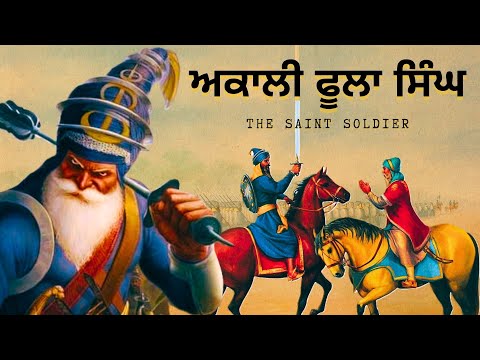
Akali Phula Singh
Akali Phula Singh Nihang was an Akali Nihang Sikh leader. He was a saint soldier of the Khalsa Shaheedan Misl and head of the Budha Dal in the early 19th century. He was also a senior general in the Sikh Khalsa Army and commander of the irregular Nihang of the army. He played a role in uniting Sikh misls in Amritsar. He was not afraid of the British who at many times ordered for his arrest but were not successful. During his later years he served the Sikh Empire as a direct adviser to Maharaja Ranjit Singh. He remained an army general in many famous Sikh battles up until his martyrdom in the battle of Nowshera. He was admired by the local people and had a great influence over the land and his settlement was always open to help the poor and helpless. He was well known and was a humble unique leader and prestigious warrior with high character. He was also known for his effort to maintain the values of Gurmat and the Khalsa panth.
Akali Phula Singh was born in 1761 in a Jat family, to father Sardar Ishar Singh. After his father's death Akali Phula Singh, who was still young, and his elder brother, Baba Sant Singh, were taken care of by Mahant Balram and under his mother's advice he would later be taken under the apprenticeship of Akali Baba Naina Singh, the leader of the Shaheedan Misl, and his Nihang order at Anandpur Sahib. It was from Baba Naina Singh that he would receive initiation into the Khalsa. Akali Phula Singh memorized the Nitnem (The writings of the Sikh Gurus which are recited daily by a Sikh) at a young age. As a child he would not eat until he completed memorizing a certain portion of the Sikh Guru's writings and in this way he had the Akal Ustat, 33 Savaiye, and other Sri Mukhwak Bani memorized. Around the age of fourteen Akali Phula Singh's mother also passes away after falling off stairs leaving him with the dying wishes of being virtuous, upholding dharma, helping the poor, serving the Panth, in the heart being at the refuge of the Guru, being unaffected by Moh, being a role model on the battlefield, and following the footsteps of his ancestors. This had a great impact on Akali Phula Singh who then gave away his land and his possessions to the poor to start to live the life of a Nihang Saint Soldier. He became very close to Akali Naina Singh's jatha at Anandpur Sahib where he completed his martial arts training and fought many battles. As he began to recite Gurbani with a near perfect pronunciation and began to display great dharmic strength he was made the jathedar of the Shaheedan Misl. He did considerable Seva at Anandpur Sahib which included protecting the Gurdwara from thieves and preparation of langar until eventually the Gurdwara was reformed.
The Jathedar of Amritsar
Upon hearing of news of lack of maintenance and other neglect by sevadars of the Gurdwaras in Amritsar Akali Phula Singh came to Amritsar in 1800 at this time he had under his leadership a band of about 2,000 Nihangs. He stopped the mismanagement and actively began reforming many Gurdwaras within Amritsar to the point he became responsible and accepted as being in charge of the maintenance of all Gurdwaras in the area. He did Kar Seva at the holy sorawar at Harmindar Sahib and overall cleaning of the complex with the help of about 100,000 pilgrims this lasted for about 2 months. Later in his life he made similar improvements to Sri Muktsar Sahib, Anandpur Sahib, and Damdama Sahib. Seeing Akali Phula Singh's high character and dedication, the Sangat made him the Jathedar of the Akal Takht which was initiated by the Panj Pyare.
Upon the assassination of Fateh Khan and the civil disruption that evaded the Kabul region Maharaja Ranjit Singh took advantage of the situation and advanced his army to Attock in October 1818. The Maharaja himself led the expedition to bring the rebellious Pathans under control. A bridge of boats was constructed across the river Attock and a small jatha was sent to assess the situation, but the jatha was attacked. This enraged the Maharaja. He sent Akali Phula Singh and general Hari Singh Nalwa to fight against the rebels. As soon as the Sikh army was within firing range, they were showered with a rain of bullets. Akali Phula Singh ordered a tactical retreat. This coaxed the rebels from their bunkers to expel the retreating Sikhs. When the enemy was in the open battlefield, Akali Phula Singh ordered a severe attack and then encircled them. Their commander Feroze Khan accepted his defeat and requested the Sikhs to end the battle. The rulers of Khatkha surrendered themselves to the Khalsa forces and thus were spared. The next day, the remaining Khalsa army and Maharaja Ranjit came across the river and camped there. Small contingents were stationed in the forts of Khairabad and Jahangira. The Sikh army then proceeded towards Peshawar.
Battle of Kasur
Kasur falls in fairly close proximity to Lahore and there were many Pathan-Sikh wars fought earlier between the two neighbouring empires. Previously Emperor Nizamuddin Khan agreed after battle to subdue to the Sikh empire. Nizamuddin however then broke his vow and was defeated again with Ranjit Singh forgiving him once again allowing Nizamuddin to control Kasur again. The next Nawab of Kasur and Nizamuddin son, Qutbuddin Khan, was mistreating the Sikhs and Hindus in his state and charging extra tax on them he eventually called a Jihad on the Sikh Kingdom. In February 1807 Qutbuddin Khan with the help of the Multan Nawab, Musafar Khan, gathered thousands of soldiers in Kasur where there was a big fort. Akali Phula Singh and his jatha were called to Lahore by Maharaja Ranjit Singh to fight in Kasur, Jodh Singh Ramgarhia and Hari Singh Nalwa were also called in. Akali Phula Singh and his soldiers led the attack on the Muslim Ghazis on the morning of 10 February 1807. Two battles were fought outside the city and the Singhs won both. Qutbuddin retreated to his fort as he had nowhere to go.
Encounter with Charles Metcalfe
The British Civil servant Charles Metcalfe met with Ranjit Singh at Kasur and then in February 1809 arrived in Amritsar to go to Ranjit Singh's court for the signing of the Treaty of Amritsar. Metcalfe was interested in the creation of the pastili[check spelling] boundary and establishing an English treaty made by suffledge where boundaries will be respected between British and Sikh empires. Metcalfe came with his platoon who were composed of entirely Shia Muslims. It was the Shia Muslims commemoration of Muharram and they took it upon themselves to enact this ritual in the streets of Amritsar. The army of about 100 Muslim soldiers began beating their breasts to the chants of "Hassan, Hussein, Ali" and making much noise as they came near the Harmindar Sahib complex where Akali Phula Singh and his jatha were staying.
Stay at Shri Damdama Sahib
After the Amritsar Treaty was accepted, the British Officer Captain White was sent to Punjab to survey the border line between the British and Sikh Raj. He got permission from Maharaja Ranjit Singh to set camp at that spot where he rested however he did not tell the local people what he was doing there. Around 1799 Akali Phula Singh arrived at Damdama Sahib for maintenance of Gurdwaras in the area and the starting of Gurbani recitation samagam. Here he heard the news that there was a British Regiment who wanted to capture neighboring land and were preparing maps nearby. It was also said that Captain White was mistreating the local people and displaying poor conduct. The Nihangs could not bear the British forces trying to enter Punjab for any reason.
Advice for the Maharajah
Akali Phula Singh did not like that Maharajah Ranjit Singh replaced the Bani (Language) and Bana (Clothing) of the traditional Sikh appearance blessed by the Sikh gurus, as the national army military drills were now being done in French and the traditional Bana dress was replaced with European clothing. Akali Phula Singh disapproved the treaty that Ranjit Singh created with the British Raj as he had wanted the Sikh Empire to retake all of India from the British. The Maharajah then calmed the warrior by telling him they would first subdue the Punjab, Kashmir and Tibet before taking on the British. Akali Phula Singh was also strongly against the Dogras holding any position in the government and wanted every on to be Khalsa as per Guru Gobind Singh's 52 Hukams.
Stay at Anandpur Sahib
Akali Phula Singh got into conflict with the Dogra courtiers and Brahmin officials and blamed them for causing distress and damage to Sikh Government. The courtiers were also opposing Prince Kharak Singh and Prince Sher Singh. They made it hard for Akali Phula Singh to meet with the Maharaja Ranjit Singh nor did they tell the Maharaja Ranjit Singh his requests. Akali Phula Singh admitted himself into the fort where Ranjit Singh was without the Dogra Officials or Brahmin Officials permission. He tried to persuade the Maharajah to abandon the corrupt Dogras and corrupt Brahmanis but Ranjit Singh refused. He stated that to Ranjit Singh that he was not inline with Sikhi and Gurmat and not respecting the Sikh empire that was given to him by the blessing of Maharajah Guru Gobind Singh and thus he is not happy living under this rule and with this he left Ranjit Singh. In 1814 Akali Phula Singh left his Nihanghan di Chhaoni in Amritsar and arrived in Anandpur Sahib, which was near British land and the British did not like this and saw him as a major threat. Akali Phula Singh and his Shaheedan Misl opened up a dera here.
Battle of Multan
Maharajah Ranjit Singh fought numerous battles in Multan from 1802 to 1818. In 1805 Muzaffar Khan Sadozi stopped paying taxes to the Sikh Kingdom but eventually after military defeat agreed to pay them this happened again and again at a few different occasions through the years. The last battle of 1818 is of prime significance when Muzaffar Khan again stopped paying taxes and finally flew the Jihad flag against Khalsa and called the Muslims of the adjoining territories of help. The 25,000 Sikh soldiers sent to Multan were led by Hari Singh Nalwa with Mokham Chand secondary in charge. Akali Phula Singh and the Shaheedan Dal along with the reinforcements of Nihung under Sadhu Singh and the power of Zamzama Bhangianwala Toap played a big role in this battle and was inspiration for the Sikh soldiers to fight bravery.
The army prepared to storm Peshawar and Sikh army come together to do an Ardas to Akal Purakh asking for their victory and to formalize their upcoming departure to the battlefield. Upon the completion of the ceremony Ranjit Singh heard news of the delay of General Ventura and the Sikh artillery and cannons so he told his army to stop and tried to tell the Nihang army to stop the planned attack. Akali Phula Singh refused to break the Khalsa's Gurmata made in the presence of Guru Granth Sahib to fight tonight and to fight to the last without turning back. He told Ranjit Singh to do what he may with his army but the Nihangs are leaving for battle now and won't turn back. The Akalis thus entered the battlefield first. The Nihangs charged at the army on horseback but when they reached the army they abandoned their horses and fought through the enemies with swords. Ranjit Singh seeing the Nihangs successful charge and also seeing how the Nihangs were outnumbered on the battlefield ordered the rest of the army to enter the battlefield. Prince Kharak Singh's army now charged at the enemy and General Ventura had now also arrived. Ranjit Singh ordered General Balu Bahadur's Gurkha army to attack the enemy from behind.
Akali Phula Singh helped solidate many of the ideals of the Guru Khalsa created by Guru Gobind Singh. He was a strict follower of Amrit Vela and the Sri Guru Granth Sahib and paid high importance to do Asa Ki Var daily. As a Nihang sevadar he paid his due to act upon Dharma on the populace. Nihangs do not find it necessary to obey the law of the land nor do they believe in law of property or any subjection of any kind. Akali Phula Singh made it routine to steal much wealth and weapons from rich rulers until he was confronted by Maharajah Ranjit Singh for the act after which whatever Akali Phula Singh required was provided by Maharajah Ranjeet Singh.[citation needed] The Nihangs aim to be at selfless service (seva) of the world though they are especially generous to the poor and weak. Akalis are known to be of great integrity and they are known to not break their hukam. Nihangs often slept on horses many days at time and it is their rule to be always on the move and to not stay at the same place for too long. They prefer the sword over gun but are also trained to be excellent marksmen. In warfare they are the first to attack and usually do not retreat in battle, rather they just keep charging. They do cries of Akal Akal loudly. Akali Phula Singh enforced all the qualities of the ideal Nihang.
Punishment of Ranjit Singh
Maharaja Ranjit Singh married Moran Sarkar, a Muslim nautch girl. This action, and other non-Sikh activities of the Maharaja, . upset the Sikhs community and Akali Phula Singh. When Ranjit Singh visited Amritsar for his daily listening of the Sri Guru Granth Sahib nobody spoke to him. Ranjit Singh could not bear nobody talking to him so he asked for forgiveness. Akali Phula Singh being the leader of the panth ordered Ranjit Singh to be flogged and he immediately agreed. Upon getting in the position to receive the whipping with a naked back and leaning against the tamarind tree in front of the Akal Bunga (Akal Takht) Akali Phula Singh asked if it was enough that the Maharaja was ready to receive the punishment and should be forgiven without getting the actual whipping. He asked the Sangat who had gathered around if they agreed that he should be forgiven that they should respond with the Sat Sri Akal battle cry in response the entire Sangat cried out Sat Shri Akal in approval.
Akali Phula Singh's samadhi was built at Pir Sabaq, 8 km from Nowshera to Attock, where he was killed. It had a large piece of land attached to it and was a popular place of visit for Sikhs, Hindus, and Pathans especially during Vaisakhi and Dussehra. The Nihangs served langar there up until the creation of India. Akali Phula Singh's land in Amritsar is still run by the Nihangs at the Akali Phula Singh Burj which was built by Maharajah Ranjit Singh himself as a tribute to Akali Phula Singh. The total land attached to Akali Phula Singh Burj was originally over 13 acres but now that number has been greatly reduced. The story of Phula Singh Punjabi has been immortalised in Dhola, an oral epic widely sung and performed right into the late twentieth century in Jat villages of the Braj region of western Uttar Pradesh and eastern Rajasthan.