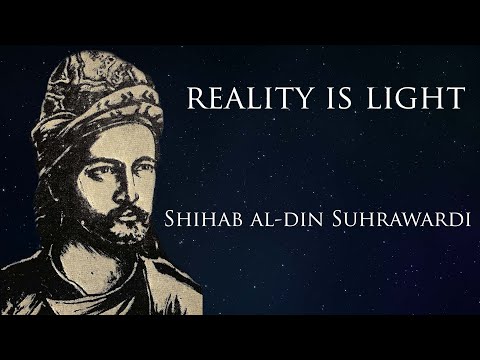
Shihab al-Din Yahya ibn Habash Suhrawardi
Shihāb al-Dīn Abū al-Futūḥ Yaḥyā ibn Ḥabash ibn Amīrak al-Suhrawardī was a Persian philosopher and founder of the Iranian school of Illuminationism, an important school in Iranian and Islamic philosophy.
Of Persian stock,[a] Suhrawardi was born in 1154 in Suhraward, a village located between the towns of Zanjan and Bijar Garrus in Iran. He learned wisdom and jurisprudence in the city of Maragheh. His teacher was Majd al-Dīn Jīlī who was also Fakhr al-Din al-Razi’s teacher. He then went to Iraq and Syria for several years and developed his knowledge while he was there. His life spanned a period of less than forty years during which he produced a series of works that established him as the founder of a new school of philosophy, called "Illuminationism" (hikmat al-Ishraq). According to Henry Corbin, Suhrawardi "came later to be called the Master of Illumination (Shaikh-i-Ishraq) because his great aim was the renaissance of ancient Iranian wisdom". which Corbin specifies in various ways as the "project of reviving the philosophy of ancient Persia". In 1186, at the age of thirty-two, he completed his magnum opus, The Philosophy of Illumination.
Suhrawardi was a strong defender of Peripatetic philosophy, until he was influenced by those whom he described as those who "have traveled the path of God", like - as noted by Suhrawardi - Plato from the Greek tradition, Hermes (Thoth) from Egypt, and Pythagoras the Phoenician, and also figures in the Persian tradition. His philosophical project aims to revive the lost hikma of east and west. It is also apparent that Suhrawardi was strongly influenced by the Sufi tradition, bearing in mind his mystical spiritual journeys that he considered a necessary prerequisite for understanding his Illuminationist philosophy. Zoroastrianism also appears to have influenced Suhrawardi, as its symbols appear in some of his works.
Arising out of peripatetic philosophy as developed by Ibn Sina (Avicenna), Suhrawardi's illuminationist philosophy is critical of several of Ibn Sina's positions and radically departs from him in creating a symbolic language (mainly derived from ancient Iranian culture or Farhang-e Khosravani) to give expression to his wisdom (hikma). Suhrawardi taught a complex and profound emanationist cosmology, in which all creation is a successive outflow from the original Supreme Light of Lights (Nur al-Anwar). The fundamental of his philosophy is pure immaterial light, where nothing is manifest, and which unfolds from the Light of Lights in a descending order of ever-diminishing intensity and, through complex interaction, gives rise to a "horizontal" array of lights, similar in conception to Platonic forms, that governs mundane reality. In other words, the universe and all levels of existence are but varying degrees of Light—light and darkness. In his division of bodies, he categorises objects in terms of their reception or non-reception of light.
Suhrawardi's Illuminationist project was to have far-reaching consequences for Islamic philosophy in Shi'ite Iran. His teachings had a strong influence on subsequent esoteric Iranian thought and the idea of “Decisive Necessity” is believed to be one of the most important innovations in the history of logical philosophical speculation, stressed by the majority of Muslim logicians and philosophers. In the 17th century, it was to initiate an Illuminationist Zoroastrian revival in the figure of the 16th century sage Azar Kayvan. Many later philosophers were influenced by the Illuminationist philosophy of Suhrawardi including Athir al-Din al-Abhari, Al-Allama al-Hilli, Ibn Abi Jumhur al-Ahsa'i, Jalal al-Din Davani, and also Mulla Sadra.
Suhrawardi thought of himself as a reviver or resuscitator of the ancient Persian wisdom. He states in Hikmat al-'Ishraq that:.mw-parser-output .templatequote{overflow:hidden;margin:1em 0;padding:0 32px}.mw-parser-output .templatequotecite{line-height:1.5em;text-align:left;margin-top:0}@media(min-width:500px){.mw-parser-output .templatequotecite{padding-left:1.6em}} There was among the ancient Persians a community of people guided by God who thus walked the true way, worthy Sage-Philosophers, with no resemblance to the Magi (Dualists). It is their precious philosophy of Light, the same as that to which the mystical experience of Plato and his predecessors bear witness, that we have revived in our book called Illuminationist Philosophy (Hikmat al-'Ishraq), and I have had no precursor in the way of such project. Suhrawardi uses pre-Islamic Iranian gnosis, synthesising it with Greek and Islamic wisdom. The main influence from pre-Islamic Iranian thought on Suhrawardi is in the realm of angelology and cosmology. He believed that the ancient Persians' wisdom was shared by Greek philosophers such as Plato as well as by the Egyptian Hermes and considered his philosophy of illumination a rediscovery of this ancient wisdom. According to Nasr, Suhrawardi provides an important link between the thought of pre-Islamic and post-Islamic Iran and a harmonious synthesis between the two. And Henry Corbin states: "In northwestern Iran, Sohravardi (d. 1191) carried out the great project of reviving the wisdom or theosophy of ancient pre-Islamic Zoroastrian Iran."
According to Hossein Nasr since Sheykh Ishraq was not translated into Western languages in the medieval period, Europeans had little knowledge about Suhrawardi and his philosophy. His school is ignored even now by later scholars. Sheykh Ishraq tried to pose a new perspective on questions like the question of Existence. He not only caused peripatetic philosophers to confront new questions but also gave new life to the body of philosophy after Avicenna. According to John Walbridge, Suhrawardi's critique on peripatetic philosophy can be counted as an important turning point for his successors. Suhrawardi tried to criticize Avicennism in a new approach. Although Suhrawardi first was a pioneer of peripatetic philosophy, he later became a Platonist following a mystical experience. He is also considered as the one who revived the ancient wisdom of Persia by his philosophy of Illumination. His followers include other Kurdish and Persian philosophers such as Shahrazuri and Qutb al-Din al-Shirazi who tried to continue the way of their teacher. Suhrawardi made a distinction between two approaches in his Illuminationism: one approach is discursive and the other is intuitive.
There are different and contradictory views regarding the character of Suhrawardi's school. Some scholars such as Hossein Ziai believe that the most important aspects of his thought are his logic and critique of the peripatetic conception of definitions.[page needed] On the other hand, scholars like Mehdi Hairi and Sayyid Jalal Addin Ashtiyyani, believe that Suhrawardi remained within the framework of peripatetic and neo-Avicennian philosophy. Mehdi Amin Razavi criticises both these groups for ignoring the mystical dimension of Suhrawardi's writings.[page needed] In turn, scholars such as Henry Corbin and Hossein Nasr view Suhrawardi as a theosophist and focus on the mystical dimension of his work.[citation needed] Viewing in another way, Nadia Maftouni has analysed Suhrawardi's works to figure out the elements of philosophy as a way of life. As she holds, the priority of practical reason to theoretical reason, the emphasis on intuition, taking philosophy as a practice of attaining optional death, and proposing ways to heal mental diseases may well be considered the main elements of philosophy as a way of life in Suhrawardi's allegorical treatises.
Suhrawardi left over 50 writings in Persian and Arabic.