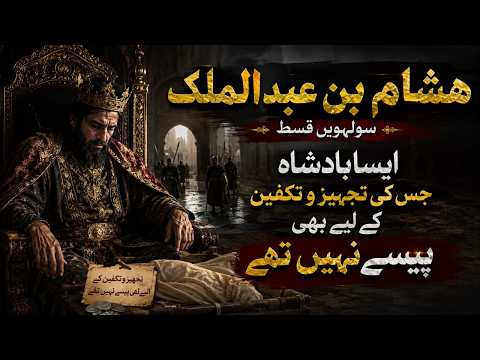
Hisham ibn Abd al-Malik
Hisham ibn Abd al-Malik ibn Marwan was the tenth Umayyad caliph, ruling from 724 until his death in 743. Hisham succeeded his brother Yazid II and presided over one of the longest reigns of the Umayyad Caliphate. His grandson Abd al-Rahman I later founded the Emirate of Córdoba.
Hisham was born in Damascus, the administrative capital of the Umayyad Caliphate, in AH 72 (691–692 CE). His father was the Umayyad caliph Abd al-Malik (r. 685–705). His mother, A'isha, was a daughter of Hisham ibn Isma'il of the Banu Makhzum, a prominent family of the Quraysh, and Abd al-Malik's longtime governor of the Islamic holy cities of Mecca and Medina.[b] According to the history of al-Tabari (d. 923), Hisham was given the kunya (patronymic) of Abu al-Walid. There is little information about Hisham's early life. He was too young to play any political or military role during his father's reign. He supposedly led the Hajj pilgrimage to Mecca once during his brother al-Walid I's reign (r. 705–715) and while there, met a respected descendant of Caliph Ali (r. 656–661), Zayn al-Abidin. Hisham is credited by al-Tabari for leading an expedition against the Byzantines across the Caliphate's frontier in 706 and capturing a number of their fortified positions.
Under Hisham, the northern frontiers, the Jazira, and Iraq experienced a major economic revitalization. Following the final pacification of the Jazira and Iraq at the beginning of the eighth century, Hisham and the elites of his court heavily invested in the development of irrigation farming and the promotion of interregional trade across northern Syria, the Jazira, and Iraq. The region, which had seen a decline in exchange routes since the Roman–Persian frontier split the Euphrates valley in late antiquity, regained its importance as a major zone of communication and interaction. Hisham accumulated substantial revenues from agricultural estates around Resafa, Raqqa, Mosul, and Edessa, as well as from the area irrigated by the Nahr Dawrin south of the Khabur outlet. Alongside the caliph, wealthy entrepreneurs such as his half-brother Maslama ibn Abd al-Malik and his long-serving governor of Iraq, Khalid al-Qasri, derived immense wealth from land cultivation and commercial ventures in the region.
Accession
Upon the counsel of their brother, the prominent general Maslama ibn Abd al-Malik, Yazid nominated Hisham as his successor over his own son al-Walid II, whom he had originally intended to designate as first-in-line. Hisham acceded after Yazid died in January 724. He received the news while at his Syrian desert estate, al-Zaytuna, which is identified as Qasr al-Hayr al-Gharbi, near Hisham's favored residence, al-Rusafa, which is identified as Qasr al-Hayr al-Sharqi. He was given the caliphal ring and staff by a postal messenger, after which he rode to Damascus, where he was publicly acclaimed as caliph.
Provincial politics
Among Hisham's first acts was the dismissal of Umar ibn Hubayra al-Fazari from the governorship of Iraq in March 724. Ibn Hubayra had governed as a partisan stalwart of the Qays–Mudar, one of the two tribal-military factions of the caliphate, and aggressively suppressed the opposing Yaman–Rabi'a and its champions, the Muhallabid family. Hisham aimed to neutralize the partisan politics in the eastern caliphate by replacing Ibn Hubayra with Khalid ibn Abdallah al-Qasri, a staunch loyalist of the Umayyad family and member of the factionally neutral Bajila tribe. Hisham extended Khalid's jurisdiction beyond Iraq to the Iranian provinces and Khurasan, i.e. the eastern half of the caliphate. Khalid played a role similar to the Umayyads' former powerful viceroys of the east, Ziyad ibn Abihi and al-Hajjaj ibn Yusuf, though he lacked their reputation for statesmanship and energetic leadership.
External challenges
During the reign of Caliph al-Walid I (r. 705–715), the territories east of Khurasan, in particular Transoxiana and Tukharistan, had been conquered by Umayyad forces but other than the Arab garrisons set up in Samarkand, Bukhara and Balkh, these regions remained largely self-administered by local Iranian and Turkic rulers. Not long after the conquests, there rose a confederation of Turkic nomads in Transoxiana, the Chinese-backed Turgesh under the khaqan Suluk, which countered Arab influence. The Arab troops of Khurasan (ahl Khurasan, 'the Khurasani army') were riven by divisions along Qaysi–Mudari and Yamani-Raba'i factional lines, which weakened their standing.
Berber revolt
In North Africa, Kharijite teachings combined with natural local restlessness to produce a significant Berber revolt. In 740, a large Berber force surrounded a loyal army at Wadi Sherif, where the loyalists fought to the death. Hisham dispatched a force of 27,000 Syrians, which was destroyed in 741. In 742 Hanzala ibn Safwan began successfully, but soon was besieged in Qayrawan. He led a desperate sortie from the city that scattered the Berbers, killing thousands and re-establishing Umayyad rule.
Invasion of Gaul
In Al-Andalus, the internal conflicts of the years past were ended, and Hisham's governor, Abd al-Rahman ibn Abd Allah, assembled a large army that went into Gaul. He besieged Bordeaux and pushed to the Loire. This marked the limit of Arabic conquest in Gaul. The wave was halted at the Battle of Tours by Charles Martel who ruled the kingdom of the Franks, with exception of the Fraxinetum enclave which lasted until the 10th century.
Alid revolt of 740
Hisham also faced a revolt by the followers of Zayd ibn Ali, grandson of Husayn ibn Ali, which was put down because of the lack of support it received. Although he had sympathies of many people He did not receive a substantial military support. Zayd was ordered to leave Kufa and though he appeared to set out for Mecca, he returned and dwelt secretly in Kufa moving from house to house and receiving the allegiance of many people. Yusuf ibn Umar al-Thaqafi, Iraq's governor, learned of the plot, commanded the people to gather at the great mosque, locked them inside and began a search for Zayd. Zayd with some troops fought his way to the mosque and called on people to come out. He then pushed back Yusuf's troops, but was felled by an arrow. Although his body was initially buried, the spot was pointed out and it was extracted, beheaded and the head sent to Hisham and later to Medina.
In general, Hisham is viewed by modern historians and the early Islamic tradition to have overseen a successful reign, on par with the similarly long reigns of the Umayyad Caliphate's founder Mu'awiya I (r. 661–680) and Abd al-Malik. In the summation of the historian Francesco Gabrieli, Hisham's rule "on the whole was glorious for the Arabs and fruitful in the development of Islamic faith and culture" and "marks the final period of prosperity and splendour of the Umayyad caliphate". By dint of his sobriety, austerity and work ethic, Hisham is held by most modern historians to have kept the Caliphate in good standing. They largely assign blame to his successor al-Walid II and longer standing internal factors, which Hisham could not resolve, for the Umayyad dynasty's unraveling in the few years after Hisham's death. Similarly, the Islamic tradition portrays Hisham as "a conscientious and efficient, if severe and tightfisted, administrator", according to Blankinship. In the view of the historian Hugh N. Kennedy, the Umayyad state "had never been as strong as it had been under Hisham only a decade before the final collapse" in 750.
Hisham had five wives, all members of the Umayyad clan, from whom he had eight children. He had seven other children by umm walads (freed slave concubines). His favorite wife was Umm Hakim, the daughter of Yahya ibn al-Hakam, brother of Hisham's grandfather caliph Marwan I (r. 684–685). Her mother was Zaynab bint Abd al-Rahman, the granddaughter of a distinguished commander of the Islamic conquest of Syria, al-Harith ibn Hisham of the Banu Makhzum. Umm Hakim, like her mother, was well-known for her beauty and love for wine. She gave Hisham five sons, including Sulayman, Maslama, Yazid al-Afqam, and Mu'awiya. Hisham was also married to Umm Uthman, a daughter of Sa'id ibn Khalid ibn Amr. The latter was a great-grandson of the third caliph Uthman (r. 644–656) and one of the wealthiest people of his day, who used to divide his time between Syria and Medina. Umm Uthman gave birth to Hisham's son Sa'id. Hisham was also married to Ruqayya bint Abd Allah ibn Amr, a great-granddaughter of Caliph Uthman. Another of his Umayyad wives was Abda, the daughter of Abd Allah ibn Yazid (granddaughter of Caliph Yazid I, r. 680–683). Abda was killed by the Abbasids in Homs in 750. Hisham's other sons were Muhammad, Abd Allah, Marwan, Abd al-Rahman and Quraysh. He had a daughter, A'isha, to whom he granted an estate at Ras Kayfa.