The Message (1976 film)
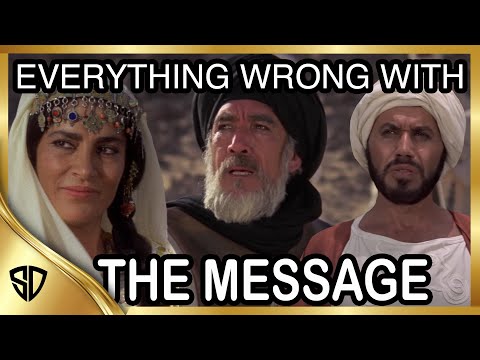
The Message originally known as Mohammed, Messenger of God is a 1976 epic film directed and produced by Moustapha Akkad that chronicles the life and times of Muhammad, who is never directly depicted.
The film begins with Muhammad sending an invitation to accept Islam to the surrounding rulers: Heraclius, the Byzantine Emperor; Muqawqis, the Patriarch of Alexandria; Kisra, the Sasanian Emperor. Earlier, Muhammad is visited by the angel Gabriel, which shocks him deeply. The angel asks him to start and spread the Quran. Gradually, a small number of people in the city of Mecca begin to convert. Observing this, more enemies come and hunt Muhammad and his companions from Mecca and confiscate their possessions. Some of these followers fled to Abyssinia to seek refuge with the protection given by the king there. They head north, where they receive a warm welcome in the city of Medina and build the first Islamic mosque (Quba Mosque). They are told that their possessions are being sold in Mecca on the market. Muhammad chooses peace for a moment, but still gets permission to attack. They are attacked but win the Battle of Badr. The Meccans, desiring revenge, fight back with three thousand men in the Battle of Uhud, killing Hamza. The Muslims run after the Meccans and leave the camp unprotected. Because of this, they are surprised by riders from behind, so they lose the battle. The Meccans and the Muslims close a ten-year truce.
The scholars and historians of Islam - The University of Al-Azhar in Cairo The High Islamic Congress of the Shiat in Lebanon have approved the accuracy and fidelity of this film. The makers of this film honor the Islamic tradition which holds that the impersonation of the prophet offends against the spirituality of his message. Therefore, the person of Mohammad will not be shown. Moustapha Akkad considered creating a film about Muhammad and the birth of Islam in 1967. The film's script, written by H.A.L. Craig, was approved in its entirety by Tawfiq al-Hakim, a scholar at Al-Azhar University. However, the film's approval was revoked and referred to as "an insult to Islam". Ahmed Asmat Abdel-Meguid and Mowaffak Allaf, the permanent representatives to the United Nations for Egypt and Syria, praised the film for its depiction of Islam. While creating The Message, director Akkad, who was Muslim, consulted Islamic clerics in a thorough attempt to be respectful towards Islam and its views on portraying Muhammad. It was rejected by the Muslim World League in Mecca, Saudi Arabia.[citation needed]
In July 1976, five days before the film opened in London's West End, threatening phone calls to a cinema prompted Akkad to change the title from Mohammed, Messenger of God to The Message, at a cost of £50,000. The film was banned in Egypt, Kuwait, and Saudi Arabia (until 2018). Irwin Yablans distributed the film in the United States. As the film was scheduled to premiere in the United States, a splinter group of the black nationalist Nation of Islam calling itself the Hanafi Movement staged a siege of the Washington, D.C. chapter of the B'nai B'rith. Under the mistaken belief that Anthony Quinn played Muhammad in the film, the group threatened to blow up the building and its inhabitants unless the film's opening was cancelled. The movie was pulled from theaters on the day of its premiere, but resumed playing after the siege ended. Akkad offered to show the film to the Hanafi Muslims and said that he would destroy the film if they found it offensive. The standoff was resolved after the deaths of a journalist and a policeman,[citation needed] but "the film's American box office prospects never recovered from the unfortunate controversy."
The film needed to gross $35 million to break even, but only earned $5 million during its theatrical run, with $2 million coming from the United States. Sunday Times film critic Dilys Powell described the film as a "Western ... crossed with Early Christian". She noted a similar avoidance of direct depictions of Jesus in early biblical films, and suggested that "from an artistic as well as a religious point of view the film is absolutely right". Variety praised the "stunning" photography, "superbly rendered" battle scenes and the "strong and convincing" cast, though the second half of the film was called "facile stuff and anticlimactic." Charles Champlin of the Los Angeles Times thought the battle scenes were "spectacularly done" and that Anthony Quinn's "dignity and stature" were right for his role. Gene Siskel of the Chicago Tribune gave it two stars out of four, calling it "a decent, big-budget religious movie. No more, no less." Alexander Walker, writing for the Evening Standard, praised the film and said that "I found myself wholly absorbed by it". Bob Thomas, writing in the Associated Press, stated that the film "is a reverent, plodding (three hours) ultimately rewarding epic of the birth of Islam".
The film was nominated for an Oscar in 1977 for Best Original Score for the music by Maurice Jarre.
The musical score of The Message was composed and conducted by Maurice Jarre and performed by the London Symphony Orchestra. The film's release in India in 2007/8 was accompanied by a different soundtrack by multiple artists, featuring unique tracks dedicated to the prophet notably "Marhaba Mustapha" by Indian music composer A. R. Rahman. Rahman went onto direct the soundtrack of another film on the prophet, Majid Majidi's Muhammad: The Messenger of God (2015).
In October 2008, producer Oscar Zoghbi revealed plans to "revamp the 1976 movie and give it a modern twist", according to IMDb and the World Entertainment News Network. He hoped to shoot the remake, tentatively titled The Messenger of Peace, in the cities of Mecca and Medina in Saudi Arabia. In February 2009, Barrie M. Osborne, producer of The Matrix and The Lord of the Rings film trilogies, was attached to produce a new film about Muhammad. The film was to be financed by a Qatari media company and was to be supervised by Sheikh Yusuf al-Qaradawi.